The Wellness Economy: Why Every CEO Should Pay Attention | How Preventive Health, Consumer Behavior, and Innovation Are Reshaping Global Business
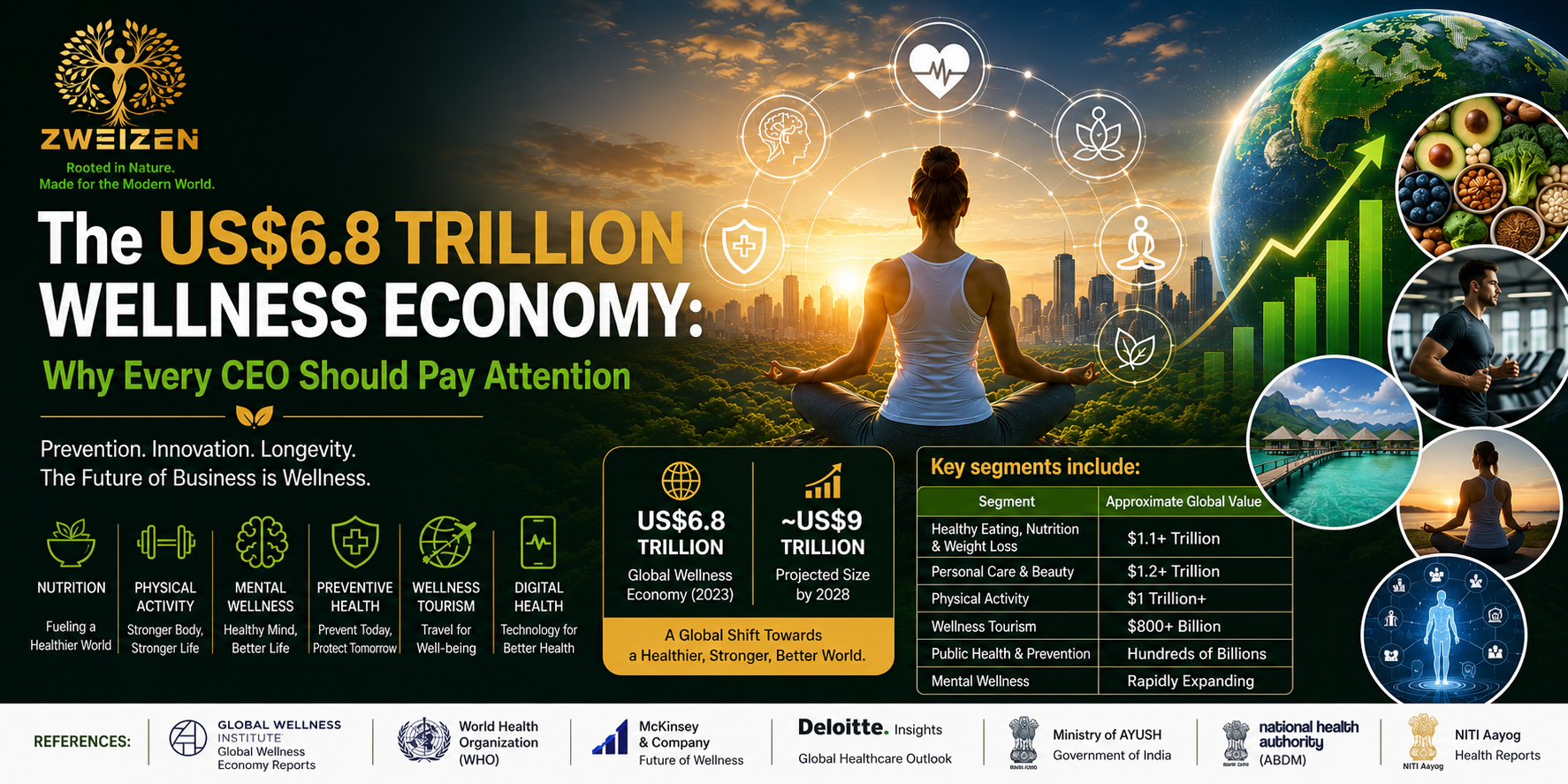
The Wellness Economy: Why Every CEO Should Pay Attention
How Preventive Health, Consumer Behavior, and Innovation Are Reshaping Global Business
Table of Contents
- Executive Summary
- Introduction
- The Evolution of the Wellness Economy
- Global Market Analysis
- India's Strategic Opportunity
- Consumer Behaviour & Preventive Health
- AI, Digital Health & Innovation
- Investment & Startup Landscape
- Challenges, Governance & Trust
- The Future of Wellness (2026–2035)
- Conclusion
- Final CEO Perspective
- Executive FAQ
- References
Executive Summary
The world is entering a new economic era.
Over the past century, every major wave of economic growth has been driven by a transformative force. Industrialization accelerated manufacturing. The internet connected billions of people and redefined communication. Smartphones reshaped consumer behavior, while Artificial Intelligence is now transforming how organizations operate, innovate, and compete.
Today, another transformation is quietly reshaping the global economy—not through machines or software alone, but through people.
It is the Wellness Economy.
Across every continent, individuals are changing how they think about health. Rather than waiting to become patients, consumers are increasingly investing in preventive healthcare, balanced nutrition, physical activity, quality sleep, stress management, mental well-being, healthy ageing, and digital health solutions. This shift is creating one of the largest and fastest-growing economic ecosystems in the world.
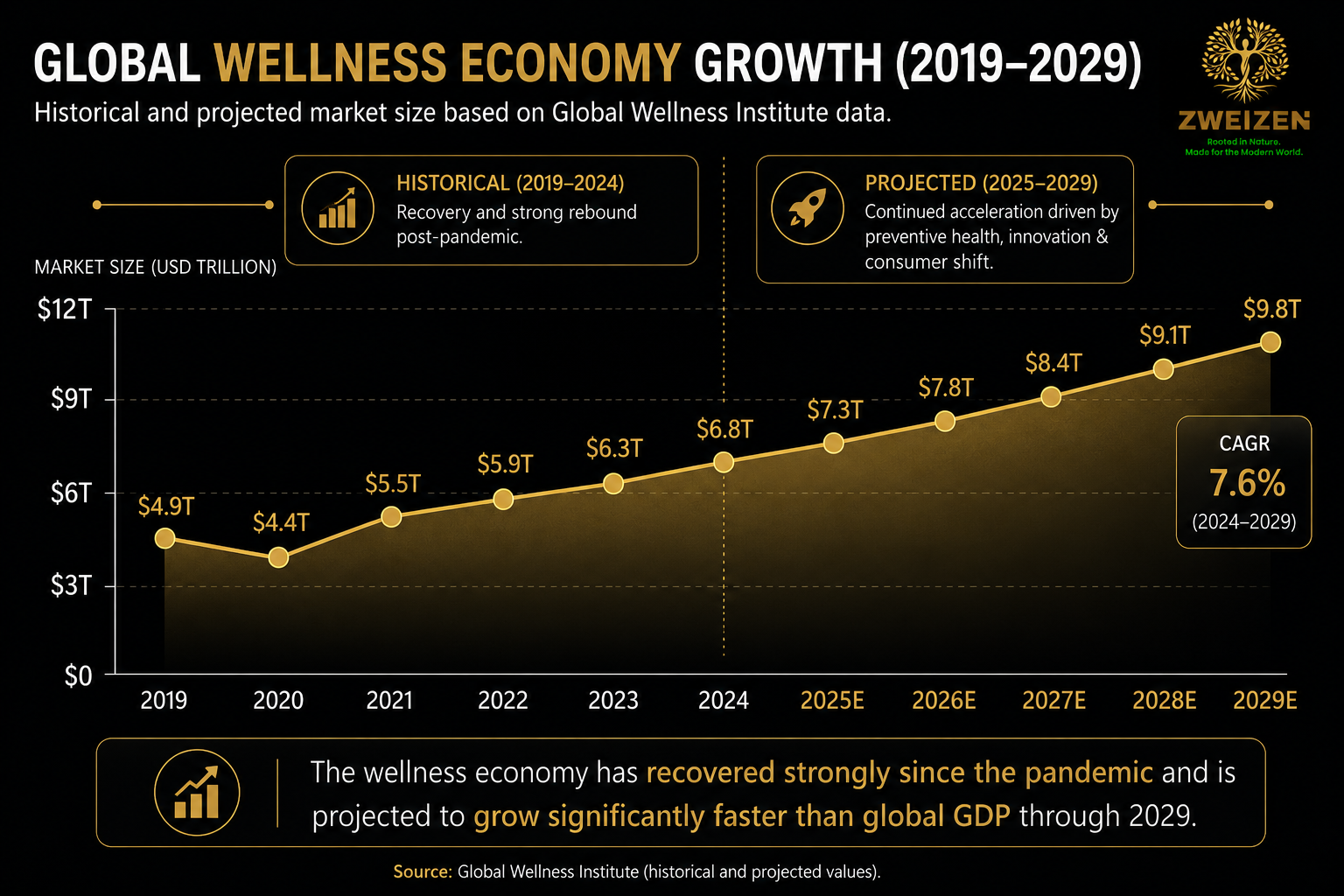
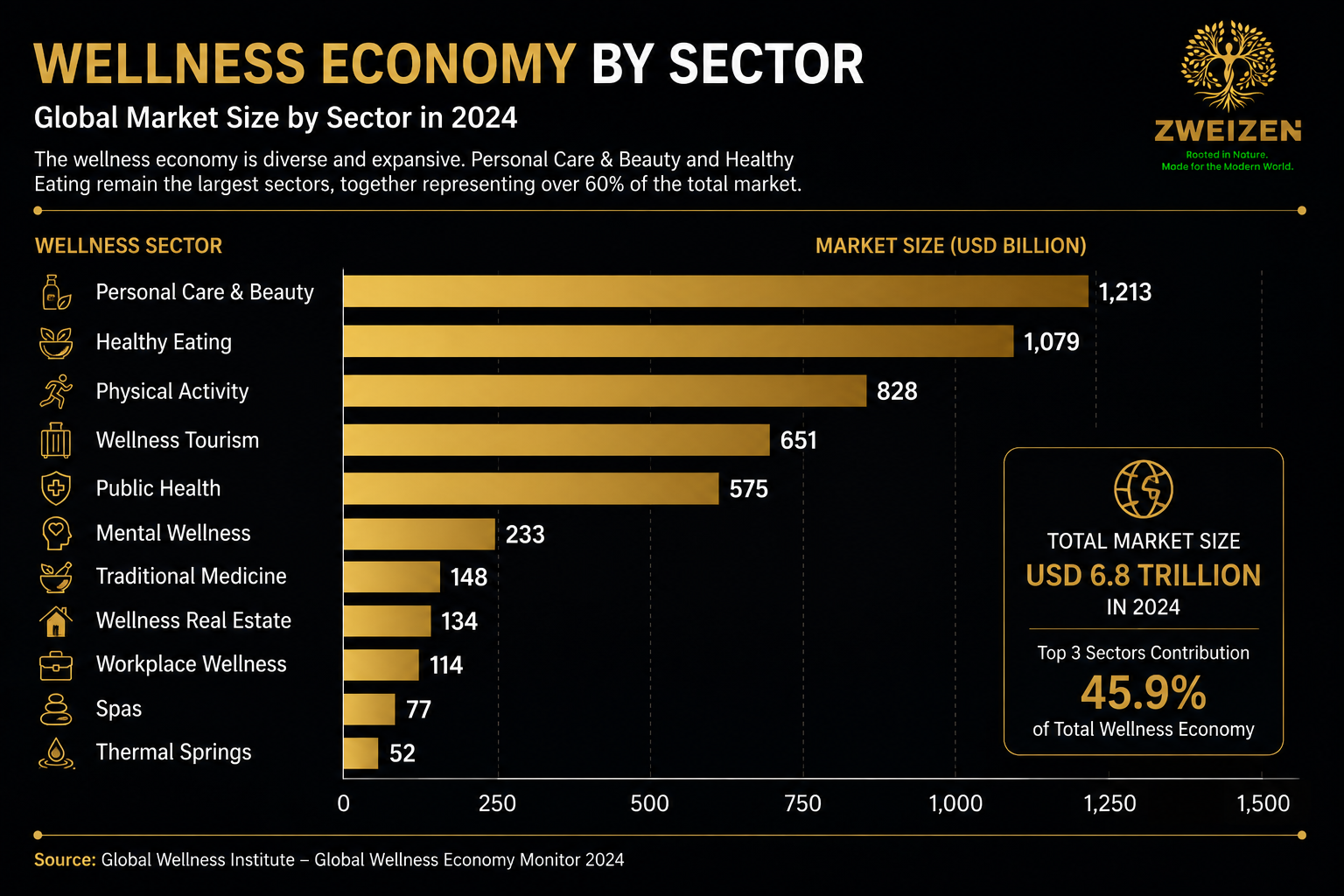
According to the Global Wellness Institute (GWI), the global wellness economy reached US$6.8 trillion in 2024, representing approximately 6.1% of global GDP. The sector is projected to expand to nearly US$9.8 trillion by 2029, growing at an annual rate of approximately 7.6%, significantly faster than expected global economic growth. These figures demonstrate that wellness is no longer a niche consumer category—it has become a major driver of economic activity. Global Wellness Institute – 2025 Global Wellness Economy Monitor
This transformation extends far beyond healthcare.
The wellness economy now influences industries including food and nutrition, pharmaceuticals, consumer goods, insurance, hospitality, technology, education, real estate, workplace strategy, financial services, and manufacturing. Organizations that once viewed health as an employee benefit or a healthcare issue now recognize it as a strategic business priority.
Several long-term global trends are accelerating this transformation.
Populations are ageing.
Lifestyle-related health conditions continue to increase.
Healthcare expenditure is rising across developed and emerging economies.
Consumers are demanding greater transparency and healthier products.
Artificial Intelligence and digital health technologies are enabling personalized wellness experiences at scale.
Governments are investing more heavily in preventive healthcare to improve public health outcomes while reducing long-term healthcare costs.
Together, these forces are creating a structural economic shift that is unlikely to reverse.
For business leaders, this represents both an opportunity and a responsibility.
Companies that understand the wellness economy can develop innovative products, strengthen customer trust, improve workforce productivity, attract long-term investment, and build more resilient organizations. Those that fail to recognize these changes risk falling behind as consumer expectations continue to evolve.
India occupies a particularly important position within this transformation.
With one of the world's youngest populations, a rapidly expanding middle class, internationally recognized wellness traditions such as Ayurveda and Yoga, strong pharmaceutical and nutraceutical manufacturing capabilities, and an increasingly sophisticated digital economy, India possesses many of the ingredients required to become a global leader in preventive wellness.
Government initiatives including the Ministry of AYUSH, the Ayushman Bharat Digital Mission (ABDM), Startup India, and Digital India are helping create an environment that encourages innovation, entrepreneurship, research, and responsible healthcare delivery. These initiatives provide a strong foundation for India's wellness ecosystem to grow domestically while expanding internationally. Ministry of AYUSH Ayushman Bharat Digital Mission
However, market growth alone will not determine future leaders.
The companies that succeed over the next decade will be those that build trust through quality, transparency, scientific integrity, responsible communication, and strong corporate governance.
In the wellness economy, reputation may become as valuable as innovation.
This article examines the forces driving the global wellness economy and explores why preventive health has become one of the defining business opportunities of our time. Drawing upon research from international institutions, government reports, market intelligence, and industry analysis, it provides a strategic perspective for CEOs, founders, investors, policymakers, and business leaders seeking to understand how wellness is reshaping the future of global commerce.
Ultimately, the wellness economy is not simply about healthier products or expanding markets.
It is about redefining how organizations create value.
It is about recognizing that healthier employees build stronger businesses, healthier consumers create more sustainable markets, and healthier societies support more resilient economies.
The future of business will increasingly belong to organizations that understand a simple but powerful truth:
Creating long-term economic value and improving human well-being are no longer separate objectives. They are becoming the same mission.
"Health is no longer merely a medical issue. It has become one of the world's most valuable economic assets."
Introduction
A New Definition of Growth in the Twenty-First Century
Every generation experiences an economic transformation that fundamentally changes how businesses compete, how consumers make decisions, and how societies define progress.
The Industrial Revolution transformed manufacturing and created modern economies.
The internet revolution connected billions of people, making information instantly accessible and reshaping global commerce.
The smartphone era revolutionized communication, consumer behavior, and digital business models.
Today, Artificial Intelligence is redefining productivity, automation, and decision-making across nearly every industry.
Yet another transformation is quietly unfolding—one that is less visible than technological innovation but potentially more influential over the coming decades.
It is changing how people think about health.
It is changing how governments design public policy.
It is changing how companies create value.
It is changing how investors allocate capital.
This transformation is known as the Wellness Economy.
Unlike many economic shifts driven primarily by technology, regulation, or financial markets, the wellness economy is driven by something much more fundamental: human behaviour.
Around the world, people are making different choices.
Instead of asking, "How do I recover from illness?"
They are increasingly asking,
"How do I stay healthy?"
That single change in perspective is reshaping one of the largest economic ecosystems on earth.
From Reactive Healthcare to Preventive Living
For much of modern history, healthcare systems were designed to respond after illness occurred.
Medical science achieved extraordinary progress in diagnosing diseases, improving surgical procedures, developing life-saving medicines, and increasing life expectancy.
These achievements transformed human civilization.
However, the challenges of the twenty-first century are different.
Today, many countries face increasing rates of non-communicable diseases such as cardiovascular disease, diabetes, obesity, and certain cancers. Many of these conditions are influenced by lifestyle, environmental, and behavioural factors alongside genetics. According to the World Health Organization (WHO), non-communicable diseases account for approximately 74% of all deaths globally, making prevention and healthier lifestyles increasingly important public health priorities. World Health Organization – Noncommunicable Diseases
The global conversation is therefore expanding.
Healthcare remains essential.
But prevention is becoming equally important.
Governments recognize that reducing preventable health risks can improve quality of life while easing long-term healthcare costs.
Businesses recognize that healthier employees contribute to greater productivity, engagement, and innovation.
Consumers recognize that investing in healthier habits today may improve their well-being tomorrow.
This collective shift is creating entirely new markets.
My Journey: From Technology to Wellness
My own understanding of the wellness economy did not begin with market research.
It began with observation.
Before founding Zweizen, I spent years in the technology industry.
Like many professionals, I was surrounded by intelligent, ambitious individuals working tirelessly to build software, solve complex business challenges, and deliver results under demanding timelines.
We celebrated innovation.
We celebrated productivity.
We celebrated growth.
Yet behind those achievements, I noticed another reality.
Long working hours had become normal.
Late-night deadlines became routine.
Meals were often skipped or replaced with convenience foods.
Physical activity became increasingly difficult to maintain.
Stress became part of everyday life.
Sleep was frequently sacrificed in pursuit of professional success.
The irony was striking.
We invested enormous effort in building businesses while unintentionally neglecting the very foundation that made those businesses possible—our health.
That realization stayed with me.
It challenged my own definition of success.
Because success without health eventually becomes difficult to enjoy.
This experience became one of the inspirations behind establishing Zweizen.
Not because I believed another wellness company was needed.
But because I believed there was a growing need for a more meaningful conversation.
A conversation centred on prevention rather than reaction.
Education rather than misinformation.
Trust rather than exaggerated claims.
Long-term well-being rather than short-term trends.
Wellness Is No Longer a Lifestyle Choice Alone
For many years, wellness was often associated with luxury.
Spa resorts.
Fitness clubs.
Organic food.
Premium nutrition.
Meditation retreats.
Today, that perception has fundamentally changed.
Wellness has become increasingly mainstream because the challenges it addresses have become mainstream.
Urbanisation has changed how people live.
Digital technology has changed how people work.
Globalisation has changed how people eat.
Modern lifestyles have increased convenience while also creating new health challenges related to inactivity, stress, sleep, and nutrition.
As these realities evolve, consumers are actively seeking ways to build healthier routines.
This is why the wellness economy continues to expand across virtually every region of the world.
It is responding to genuine societal needs rather than temporary consumer preferences.
The CEO Perspective
For business leaders, the wellness economy should not be viewed as another consumer trend.
It represents a strategic shift in value creation.
Consumers increasingly expect transparency.
Employees increasingly prioritize well-being when choosing employers.
Investors increasingly evaluate companies on long-term sustainability and governance.
Governments increasingly encourage preventive health initiatives.
Technology companies are developing digital health ecosystems.
Insurance providers are exploring incentive-based preventive care.
Food companies are reformulating products to meet evolving nutritional expectations.
Real estate developers are incorporating healthier building standards.
Hospitality companies are designing wellness-centered experiences.
Almost every sector of the economy is being influenced in some way by the changing relationship between people and health.
This makes wellness not simply a healthcare issue.
It makes wellness a business issue.
Why This Article Matters
This article has been written for business leaders rather than healthcare professionals alone.
Its purpose is not to discuss medical treatments.
Nor is it intended to promote individual products.
Instead, it explores one of the most important economic transformations shaping the next decade.
Throughout the following sections, we will examine:
- How the wellness economy evolved into a multi-trillion-dollar global market.
- The forces driving its continued expansion.
- India's strategic opportunity to become a global wellness leader.
- The role of consumer behaviour, technology, artificial intelligence, and preventive healthcare.
- Emerging investment trends.
- Business opportunities for founders and enterprises.
- Challenges related to governance, regulation, and trust.
- The future direction of the wellness economy between 2026 and 2035.
Most importantly, we will explore why this transformation matters to every CEO—regardless of industry.
Because whether you lead a technology company, a manufacturing business, a financial institution, a healthcare organization, or a consumer brand, the wellness economy is no longer operating at the edges of business.
It is becoming part of the core.
The organizations that recognize this shift today will be better prepared to create sustainable value tomorrow.
The Evolution of the Wellness Economy
From Ancient Wisdom to a US$6.8 Trillion Global Industry
The wellness economy did not emerge overnight.
It is the result of thousands of years of human experience, scientific advancement, economic development, and changing consumer priorities.
While today's wellness industry is powered by digital technologies, artificial intelligence, biotechnology, and data-driven personalization, its foundations were established long before modern healthcare systems existed.
Across ancient civilizations—including India, China, Egypt, Greece, and Rome—health was understood as more than the absence of disease. It was viewed as a state of balance between the body, mind, environment, nutrition, and daily lifestyle.
In India, Ayurveda emphasized the importance of preventive living through balanced nutrition, daily routines, seasonal practices, physical activity, adequate sleep, and harmony between the individual and nature. Although modern medicine has transformed healthcare through scientific discovery, many preventive lifestyle principles remain relevant today and continue to influence contemporary wellness practices.
For centuries, however, healthcare systems around the world evolved primarily toward diagnosing and treating illness. This shift produced remarkable achievements, including vaccines, antibiotics, advanced surgical procedures, medical imaging, and longer life expectancy.
According to the World Health Organization (WHO), global life expectancy increased from approximately 46 years in 1950 to more than 73 years by 2023, reflecting extraordinary advances in medical science and public health. World Health Organization
Yet as people began living longer, the world's health challenges also changed.
The Rise of Lifestyle Diseases
The twenty-first century has introduced a new public health reality.
Many of today's most significant health challenges are closely linked to lifestyle and environmental factors rather than infectious diseases alone.
Sedentary work.
Urban living.
Highly processed diets.
Poor sleep.
Chronic stress.
Reduced physical activity.
Digital overload.
These factors have contributed to the growing burden of non-communicable diseases (NCDs).
The World Health Organization estimates that non-communicable diseases account for approximately 41 million deaths every year, representing around 74% of all global deaths. Cardiovascular diseases remain the leading cause, followed by cancers, chronic respiratory diseases, and diabetes. World Health Organization – Noncommunicable Diseases
These figures have changed the global conversation.
Healthcare systems can continue improving treatments.
But governments, businesses, and individuals increasingly recognize that treatment alone cannot address the growing burden of preventable health risks.
This realization has elevated prevention from a personal choice to an economic necessity.
From Healthcare to Wellness
Historically, healthcare focused on extending life.
Today, wellness focuses on improving the quality of that life.
This distinction is subtle but important.
Healthcare asks:
"How can we diagnose and treat illness effectively?"
The wellness economy asks:
"How can individuals build healthier lives before illness develops?"
These two approaches complement one another.
Neither replaces the other.
Instead, they represent two sides of a modern health ecosystem.
Consumers increasingly understand that health is influenced not only by hospitals and medicines but also by daily habits, nutrition, movement, sleep, mental well-being, workplace environments, and social connections.
As awareness has grown, consumer spending has shifted accordingly.
COVID-19 Accelerated a Global Mindset Shift
Although the wellness economy was expanding well before 2020, the COVID-19 pandemic dramatically accelerated public awareness of health and resilience.
The pandemic reminded the world that health is interconnected.
Personal health influences families.
Workplaces.
Communities.
Economies.
Global supply chains.
Entire nations.
Consumers became more conscious of immune health, nutrition, fitness, sleep quality, stress management, and mental well-being.
Employers expanded wellness initiatives.
Governments increased investment in digital health infrastructure.
Healthcare innovation accelerated at unprecedented speed.
The pandemic did not create the wellness economy.
It accelerated trends that were already underway.
According to McKinsey & Company, consumers across multiple countries continue to prioritize wellness even after the pandemic, demonstrating that healthier lifestyles have become a long-term behavioural shift rather than a temporary response to a global crisis. McKinsey & Company – Future of Wellness
The Digital Revolution Meets Wellness
Technology has fundamentally changed how people manage their health.
A decade ago, many individuals relied primarily on annual medical check-ups.
Today, smartphones and wearable devices enable people to monitor aspects of their daily routines such as activity levels, sleep patterns, heart rate, and exercise consistency.
Artificial Intelligence is making wellness even more personalized by supporting habit tracking, nutritional guidance, educational content, and digital coaching.
Telemedicine has expanded access to healthcare services.
Health applications encourage healthier daily routines.
Digital communities provide motivation and accountability.
The future of wellness is increasingly digital—not because technology replaces healthcare professionals, but because it helps individuals make more informed lifestyle decisions.
Consumers Are Investing in Prevention
Perhaps the most significant transformation is psychological.
Consumers no longer see wellness as a luxury.
They increasingly view it as an investment.
People willingly invest in healthier food, fitness memberships, wellness education, preventive health check-ups, stress management, mental well-being, and digital wellness tools because they recognize the long-term value of maintaining their health.
This represents a fundamental shift in consumer behaviour.
Instead of asking:
"How much does this cost?"
Many consumers now ask:
"How much value will this add to my long-term well-being?"
That change in thinking is one of the strongest drivers behind the wellness economy.
Wellness Is Becoming a Business Strategy
The evolution of wellness is not limited to consumers.
Businesses are also changing.
Leading organizations increasingly integrate wellness into their corporate strategies.
Employee well-being is now linked to productivity, innovation, retention, and organizational culture.
Insurance providers explore preventive health incentives.
Food companies reformulate products to meet changing nutritional expectations.
Hospitality brands develop wellness-focused travel experiences.
Real estate developers design healthier buildings with improved air quality, natural lighting, and green spaces.
Technology companies invest in digital health ecosystems.
This convergence demonstrates that wellness is no longer a standalone industry.
It is becoming a strategic capability across multiple sectors.
The Global Wellness Economy Today
The cumulative effect of these developments is remarkable.
What began as a collection of independent industries has evolved into one of the world's largest economic ecosystems.
According to the Global Wellness Institute, the global wellness economy reached US$6.8 trillion in 2024, accounting for approximately 6.1% of global GDP, and is projected to approach US$9.8 trillion by 2029 if current growth trends continue. Global Wellness Institute – 2025 Global Wellness Economy Monitor
This growth is supported by long-term demographic, technological, economic, and behavioural changes rather than short-term consumer trends.
For business leaders, this distinction is crucial.
Temporary trends create temporary opportunities.
Structural shifts create generational opportunities.
The wellness economy belongs firmly in the second category.
Why CEOs Should Care
History shows that businesses capable of recognizing structural transformations early often become industry leaders.
Companies that understood the internet early reshaped global commerce.
Organizations that embraced smartphones transformed customer experiences.
Businesses investing in Artificial Intelligence today are redefining productivity.
The wellness economy represents another such transformation.
Its impact extends beyond healthcare into manufacturing, technology, finance, consumer goods, education, insurance, hospitality, real estate, and government policy.
For CEOs, the question is no longer whether wellness will influence business.
The question is how quickly organizations can adapt to changing consumer expectations and build long-term value within this new economic landscape.
The companies that view wellness as a strategic opportunity—not simply a product category—will be best positioned to lead the next decade.
Global Market Analysis
Understanding the Scale, Growth, and Future of the Global Wellness Economy
The wellness economy has reached a point where it can no longer be viewed as a niche consumer market. It has become one of the world's largest economic ecosystems, influencing industries ranging from healthcare and food manufacturing to technology, insurance, hospitality, education, financial services, and real estate.
For CEOs, investors, policymakers, and entrepreneurs, understanding the scale of this transformation is essential. Strategic decisions are increasingly shaped not only by traditional financial indicators but also by demographic trends, consumer expectations, technological innovation, and long-term public health priorities.
The numbers clearly demonstrate that wellness has evolved into a structural growth market rather than a temporary trend.
A US$6.8 Trillion Global Economy
According to the Global Wellness Institute (GWI) 2025 Global Wellness Economy Monitor, the global wellness economy reached approximately US$6.8 trillion in 2024, representing around 6.1% of global GDP. The Institute projects that the market will expand to approximately US$9.8 trillion by 2029, reflecting an average annual growth rate of 7.6%. This rate significantly exceeds projected global GDP growth during the same period, indicating that wellness is expanding faster than many traditional industries. Global Wellness Institute – 2025 Global Wellness Economy Monitor
To appreciate the significance of this figure, consider that if the wellness economy were measured as an independent national economy, it would rank among the largest economies in the world.
This is no longer simply a healthcare discussion.
It is a macroeconomic transformation.
Wellness Is Growing Faster Than the Global Economy
One of the most compelling reasons business leaders are paying attention is the industry's sustained growth.
Between 2019 and 2024, the wellness economy recovered strongly following the pandemic and resumed growth across nearly every major sector. While many industries experienced prolonged volatility, wellness continued expanding because the underlying drivers remained intact.
Consumers continued prioritizing healthier lifestyles.
Governments continued investing in preventive healthcare.
Employers expanded workplace wellness initiatives.
Technology accelerated digital health adoption.
Investors continued funding innovation across wellness-related sectors.
These structural drivers are expected to remain influential throughout the coming decade.
Unlike industries dependent upon short-term consumer cycles, wellness benefits from long-term demographic and societal changes.
Eleven Industries Working Together
One reason the wellness economy has become exceptionally resilient is that it does not rely on a single business model.
Instead, it combines eleven interconnected industries that collectively influence how people live, work, travel, eat, exercise, and manage their well-being.
These industries include:
Healthy eating, nutrition, and weight management.
Personal care and beauty.
Physical activity.
Mental wellness.
Traditional and complementary medicine.
Public health and prevention.
Workplace wellness.
Wellness tourism.
Wellness real estate.
Spas.
Thermal and mineral springs.
Rather than competing independently, these sectors reinforce one another.
A consumer interested in healthier nutrition may also adopt regular exercise.
Someone improving sleep quality may invest in stress management.
A company introducing employee wellness initiatives may also redesign workspaces to improve physical and mental well-being.
This interconnected ecosystem creates multiple opportunities for innovation and sustainable growth.
Which Wellness Segments Are Growing the Fastest?
Although every sector contributes to the overall market, several areas are expanding particularly rapidly.
Mental Wellness has experienced significant growth as awareness of stress, anxiety, emotional well-being, and work-life balance has increased across all age groups.
Wellness Real Estate is transforming how residential and commercial buildings are designed. Developers increasingly prioritize natural lighting, indoor air quality, green spaces, walkability, and healthy building materials.
Healthy Nutrition continues evolving as consumers seek cleaner labels, plant-based products, functional foods, and personalized dietary solutions.
Physical Activity has expanded beyond traditional gyms into digital fitness platforms, wearable technologies, online coaching, and community-based wellness experiences.
Traditional and Complementary Medicine, including Ayurveda, has gained increasing international attention as consumers seek holistic approaches to everyday wellness alongside modern healthcare.
Each of these sectors addresses changing consumer priorities rather than temporary market demand.
Regional Market Performance
The wellness economy has become a truly global phenomenon.
North America remains the world's largest wellness market, supported by strong consumer spending, innovation, digital health adoption, and corporate investment.
Europe continues demonstrating steady growth through preventive healthcare initiatives, workplace wellness, healthy ageing, wellness tourism, and sustainability-focused consumer behavior.
Asia-Pacific represents one of the fastest-growing regions due to rapid urbanization, expanding middle-class populations, increasing disposable income, and strong government support for healthcare modernization.
Countries including India, China, Japan, South Korea, Singapore, and Australia continue investing heavily in wellness-related industries.
For multinational companies, Asia-Pacific represents not only an important consumer market but also an innovation hub for future wellness solutions.
Consumer Spending Is Changing
One of the most important findings from recent market research is that consumers increasingly view wellness as an investment rather than a luxury.
Households across many countries are allocating larger portions of their income toward:
Healthier food.
Fitness.
Preventive healthcare.
Mental well-being.
Sleep improvement.
Healthy ageing.
Digital wellness subscriptions.
Personalized health technologies.
Consumers increasingly understand that healthier lifestyles may improve productivity, quality of life, and long-term well-being.
This psychological shift strengthens demand across multiple industries simultaneously.
Technology Is Accelerating Market Expansion
Technology has become one of the strongest growth drivers within the wellness economy.
Artificial Intelligence enables personalized recommendations.
Wearable devices help individuals monitor daily activity and sleep.
Telemedicine expands healthcare accessibility.
Mobile applications encourage healthier habits.
Digital coaching platforms provide ongoing support.
Cloud computing enables integrated health records.
Data analytics helps organizations better understand consumer needs.
Rather than replacing traditional wellness practices, technology is making them more accessible, measurable, and scalable.
This convergence creates entirely new business opportunities.
Corporate Wellness Is Becoming a Competitive Advantage
Organizations increasingly recognize that employee well-being influences business performance.
According to Gallup, employees with higher levels of well-being tend to report stronger engagement, lower absenteeism, and improved overall workplace outcomes. While many factors contribute to organizational performance, employee well-being has become an important component of long-term workforce strategy. Gallup – Wellbeing at Work
Leading organizations now invest in:
Mental health support.
Flexible work arrangements.
Preventive health programs.
Fitness initiatives.
Leadership well-being.
Nutrition education.
Employee assistance programs.
Corporate wellness has evolved from an HR initiative into a strategic investment in organizational resilience.
Investment Trends Reflect Long-Term Confidence
Capital typically follows industries with sustained long-term growth.
The wellness economy increasingly attracts investment because it combines several attractive characteristics:
Large addressable markets.
Recurring consumer demand.
Technology integration.
Global scalability.
Demographic support.
Strong innovation potential.
Investment activity continues expanding across:
HealthTech.
Digital therapeutics.
Wearable technology.
Nutrition.
Personalized wellness.
Corporate wellness.
Preventive healthcare platforms.
AI-powered health solutions.
This indicates that investors increasingly view wellness as a durable economic opportunity rather than a temporary consumer trend.
The Strategic Message for CEOs
The data tells a clear story.
The wellness economy is no longer emerging.
It has already arrived.
Its influence extends across virtually every major industry.
Consumers are changing.
Employees are changing.
Governments are changing.
Technology is changing.
Capital markets are changing.
Businesses that continue viewing wellness as a niche category risk overlooking one of the most important structural transformations of our time.
The organizations that succeed over the coming decade will be those capable of integrating wellness into their broader strategy—not simply through products, but through innovation, governance, customer experience, employee well-being, and sustainable value creation.
The wellness economy is ultimately about much more than health.
It represents a new model for economic growth where human well-being and business performance increasingly reinforce one another.
Key Takeaways
The global wellness economy has evolved into one of the world's largest industries, valued at US$6.8 trillion in 2024.
Its projected growth significantly exceeds global GDP growth, making it one of the strongest long-term economic opportunities.
Wellness now spans eleven interconnected industries that influence nearly every aspect of modern life and business.
Technology, consumer behavior, demographic change, and preventive healthcare are collectively driving market expansion.
For CEOs and business leaders, wellness is no longer optional—it is becoming a strategic imperative.
India's Strategic Opportunity
Why India Could Become the Global Capital of Preventive Wellness
If the twenty-first century belongs to the wellness economy, then India is uniquely positioned to play a defining role in its future.
Few countries possess the combination of cultural heritage, scientific capability, manufacturing strength, entrepreneurial energy, and demographic advantage that India enjoys today.
For centuries, India has contributed knowledge systems that emphasize balance, prevention, nutrition, movement, and holistic well-being. Today, those traditions are converging with digital innovation, biotechnology, artificial intelligence, pharmaceutical manufacturing, and one of the world's fastest-growing startup ecosystems.
The result is an unprecedented opportunity.
India is no longer simply participating in the global wellness economy.
It has the potential to become one of its principal architects.
India's Demographic Dividend
Economic growth begins with people.
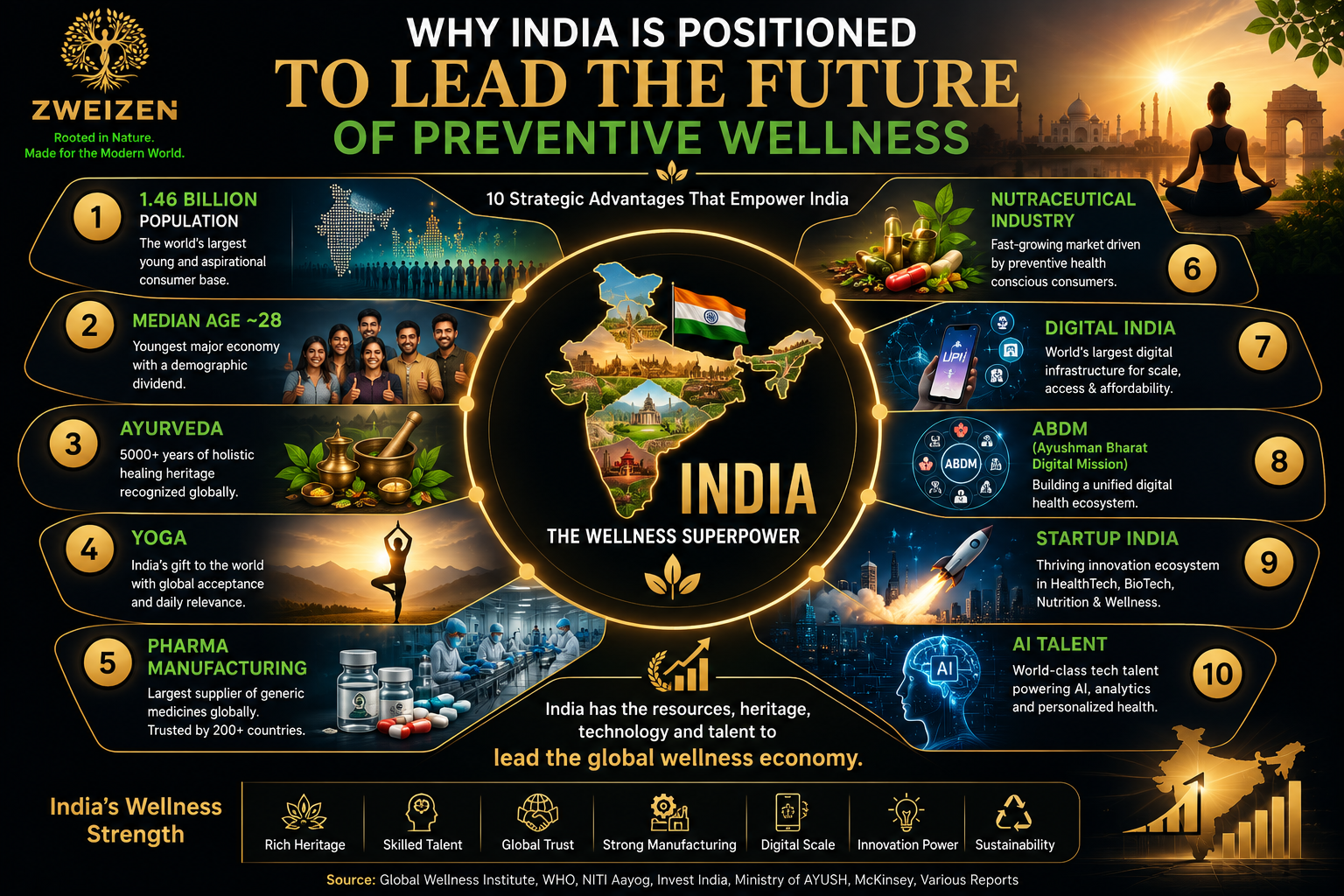
India recently became the world's most populous nation, with an estimated population exceeding 1.46 billion people. More importantly, it remains one of the world's youngest major economies, with a median age of approximately 28 years, compared with around 39 years in the United States, 40 years in China, and nearly 49 years in Japan. This demographic profile provides India with a significant long-term workforce advantage. United Nations World Population Prospects
A young population creates enormous opportunities.
It drives consumption.
It encourages entrepreneurship.
It supports innovation.
It attracts investment.
However, demographic advantage alone does not guarantee economic success.
A productive workforce must also be a healthy workforce.
As India's urban economy expands, maintaining physical and mental well-being will become increasingly important for sustaining long-term productivity and competitiveness.
Rising Incomes Are Changing Consumer Behaviour
Over the past decade, India has witnessed rapid growth in disposable incomes, urbanisation, internet connectivity, and digital payments.
This has fundamentally changed how Indian consumers think about health.
Earlier generations often viewed healthcare primarily as a response to illness.
Today's consumers increasingly invest in prevention.
They are purchasing healthier food.
Joining fitness centres.
Using wearable devices.
Consulting nutrition experts.
Exploring yoga and meditation.
Participating in preventive health check-ups.
Seeking scientifically developed wellness products.
Research by McKinsey indicates that Indian consumers are becoming significantly more health-conscious, particularly among younger professionals and urban households, where preventive wellness is increasingly viewed as part of everyday living rather than occasional healthcare expenditure. McKinsey – Future of Wellness
This behavioural shift is creating entirely new business opportunities across multiple industries.
Ayurveda: India's Global Advantage
When discussing India's position in the wellness economy, it is impossible to ignore Ayurveda.
Recognized as one of the world's oldest traditional systems of health and well-being, Ayurveda has emphasized preventive living, balanced nutrition, seasonal routines, and holistic lifestyle practices for thousands of years.
Today, global consumers increasingly seek natural ingredients, plant-based nutrition, herbal formulations, and holistic wellness approaches.
This growing interest has significantly expanded international awareness of Ayurveda.
However, heritage alone will not determine India's leadership.
Global consumers increasingly expect:
Scientific validation.
Quality assurance.
Transparent manufacturing.
Responsible communication.
International regulatory compliance.
Evidence-informed product development.
The future of Ayurveda depends on combining ancient wisdom with modern science.
That combination represents India's greatest competitive advantage.
Government Support Is Strengthening the Ecosystem
Unlike many countries, India has established dedicated institutions to support traditional systems of health.
The Ministry of AYUSH plays a central role in promoting Ayurveda, Yoga & Naturopathy, Unani, Siddha, Sowa-Rigpa, and Homoeopathy through research, education, quality standards, international collaboration, and public awareness. Ministry of AYUSH
Alongside AYUSH, several national initiatives are contributing to India's broader wellness ecosystem.
The Ayushman Bharat Digital Mission (ABDM) is building a digital health infrastructure designed to improve interoperability, accessibility, and continuity of care across the healthcare system. Ayushman Bharat Digital Mission
Programs such as Fit India, Eat Right India, and Startup India also encourage healthier lifestyles, entrepreneurship, and innovation. Together, these initiatives create a supportive policy environment for wellness businesses.
India Is Becoming a Global Manufacturing Hub
India has already established itself as one of the world's leading pharmaceutical manufacturers.
This expertise naturally extends into adjacent industries such as:
Nutraceuticals.
Botanical extracts.
Functional foods.
Dietary supplements.
Herbal wellness products.
Preventive nutrition.
India's manufacturing ecosystem offers several strategic advantages:
Highly skilled scientific talent.
Cost-efficient production.
Strong pharmaceutical infrastructure.
Increasing compliance with international manufacturing standards.
Growing export capabilities.
As global demand for wellness products continues to increase, India is well positioned to serve both domestic and international markets.
The Rise of India's HealthTech Ecosystem
India's technology ecosystem has become one of the largest in the world.
Today, healthcare and wellness innovation increasingly intersects with:
Artificial Intelligence.
Machine learning.
Telemedicine.
Digital diagnostics.
Wearable technologies.
Electronic health records.
Mobile wellness applications.
Personalized nutrition.
Health data analytics.
Government-supported digital infrastructure, combined with India's software expertise, creates opportunities for globally scalable health and wellness platforms.
Few countries possess this combination of traditional wellness knowledge and advanced digital capabilities.
A Thriving Startup Ecosystem
India now ranks among the world's largest startup ecosystems.
Thousands of entrepreneurs are building businesses across healthcare, biotechnology, digital health, diagnostics, wellness technology, nutrition, fitness, and preventive healthcare.
Government initiatives, incubators, accelerators, venture capital firms, and academic institutions continue supporting innovation across these sectors.
This environment encourages collaboration between science, technology, manufacturing, and entrepreneurship.
The next globally recognized wellness company may emerge not only from Silicon Valley—but also from Bengaluru, Hyderabad, Pune, Delhi, or Kolkata.
India's Export Opportunity
The global demand for wellness products continues to expand.
Consumers across North America, Europe, the Middle East, Southeast Asia, and Australia increasingly seek products that emphasize quality, transparency, sustainability, and responsible wellness.
India has the opportunity to become a preferred global supplier of:
Herbal wellness products.
Plant-based nutrition.
Nutraceuticals.
Ayurvedic formulations.
Functional ingredients.
Wellness technologies.
Educational wellness platforms.
Success in export markets, however, will depend upon maintaining international quality standards, strong corporate governance, traceable supply chains, and regulatory compliance.
Trust will become India's most valuable export.
Challenges That Must Be Addressed
Despite its strengths, India also faces important challenges.
Product quality remains inconsistent across parts of the industry.
Scientific research must continue expanding.
Global regulatory requirements are becoming increasingly stringent.
Consumer misinformation spreads rapidly through digital platforms.
Some businesses continue making exaggerated health claims that damage trust across the broader industry.
Addressing these challenges will require collaboration between:
Government.
Industry.
Researchers.
Healthcare professionals.
Manufacturers.
Entrepreneurs.
Responsible companies.
Long-term leadership cannot be built on marketing alone.
It must be built on credibility.
India's Moment Has Arrived
Every generation receives an opportunity to define its economic future.
For India, the wellness economy may represent one of those defining moments.
The country already possesses many of the essential ingredients.
Ancient knowledge.
Scientific capability.
Manufacturing excellence.
Digital innovation.
Entrepreneurial ambition.
A young workforce.
Government support.
Growing domestic demand.
Global recognition.
The next step is integration.
Connecting traditional wisdom with modern science.
Combining innovation with ethics.
Balancing rapid growth with quality.
Building businesses that create lasting trust.
If India succeeds in doing so, it will not simply participate in the global wellness economy.
It will help shape its future.
Key Insights
India's greatest opportunity is not simply selling wellness products.
It is becoming the world's most trusted wellness innovation ecosystem.
Countries can manufacture products.
Few can combine thousands of years of wellness knowledge with world-class technology, pharmaceutical manufacturing, entrepreneurship, and digital transformation.
That is India's unique advantage.
And it is an opportunity that has only just begun.
Consumer Behaviour & Preventive Health
Why the World's Health Priorities Are Changing—and What It Means for Business
Markets do not change unless people change.
Every major economic transformation begins with a shift in human behaviour. Consumers redefine their priorities, adopt new habits, and create demand for products and services that previously did not exist.
The wellness economy is no exception.
Its remarkable growth is not being driven primarily by advertising or product innovation. It is being driven by millions of people making different decisions every day about how they eat, sleep, exercise, work, manage stress, and think about their long-term health.
For CEOs, understanding these behavioural shifts is more valuable than understanding any single product category.
Products evolve.
Consumer expectations remain.
The Consumer Has Changed Forever
Twenty years ago, many people associated healthcare with hospitals, medicines, and emergency treatment.
Today, consumers increasingly associate health with everyday choices.
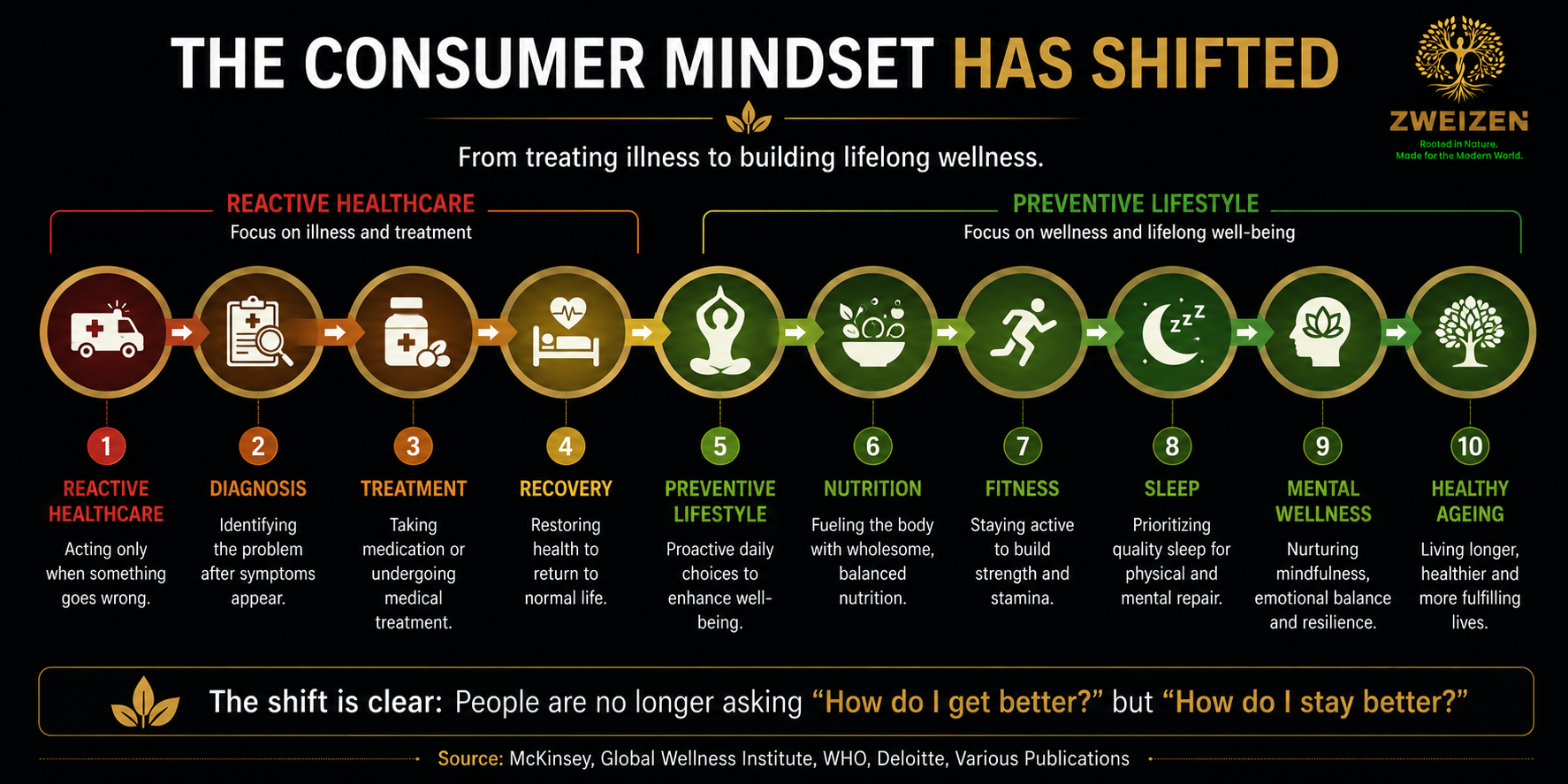
The conversation has shifted from:
"How do I recover?"
to
"How do I stay healthy?"
This represents one of the biggest behavioural transformations of modern business.
Health is no longer viewed only as a response to illness.
It has become an everyday lifestyle decision.
Consumers are becoming proactive rather than reactive.
This shift influences purchasing decisions across almost every industry.
Prevention Is Becoming the New Healthcare Model
For decades, healthcare systems worldwide were largely built around diagnosis and treatment.
While treatment remains essential, prevention is becoming equally important.
The World Health Organization estimates that approximately 74% of global deaths are caused by non-communicable diseases (NCDs) such as cardiovascular diseases, diabetes, cancers, and chronic respiratory diseases. Many of these conditions are influenced by lifestyle, environmental, and behavioural factors alongside genetics. World Health Organization – Noncommunicable Diseases
This statistic has profound economic implications.
Governments are increasing investments in preventive healthcare.
Insurance companies are exploring wellness-based incentive programs.
Employers are promoting healthier workplaces.
Consumers are investing in healthier lifestyles.
Prevention has evolved from a healthcare strategy into an economic strategy.
Health Is Becoming an Investment
Perhaps the biggest psychological change is how consumers think about spending.
Previously, health expenses were often viewed as unavoidable costs.
Today, wellness spending is increasingly viewed as an investment.
Consumers willingly invest in:
Healthier nutrition.
Fitness memberships.
Preventive health check-ups.
Mental wellness.
Sleep improvement.
Health tracking devices.
Personalized nutrition.
Digital health applications.
Educational wellness content.
Rather than asking,
"How much does this cost?"
Consumers increasingly ask,
"How will this improve my quality of life?"
That difference explains why wellness continues growing even during periods of economic uncertainty.
The Rise of the Informed Consumer
Digital technology has fundamentally changed consumer behaviour.
Information that once required a doctor's appointment is now available instantly.
Consumers compare ingredients.
Read scientific studies.
Watch expert interviews.
Follow healthcare professionals on social media.
Use Artificial Intelligence to understand health information.
Research brands before purchasing.
According to Google's consumer insights, health-related searches continue to rank among the most common search categories globally, reflecting growing public interest in preventive health, nutrition, fitness, and mental well-being. Google Trends
Today's consumers are significantly more informed than previous generations.
Consequently, businesses must become significantly more transparent.
Trust Has Become the Most Valuable Brand Asset
Consumer behaviour research consistently shows that trust influences purchasing decisions more than advertising alone.
In the wellness industry, trust is built through:
Transparent ingredient disclosure.
Scientific credibility.
Responsible communication.
Product quality.
Third-party certifications.
Customer education.
Ethical marketing.
Companies making exaggerated or misleading claims may generate short-term attention.
However, long-term success increasingly belongs to organizations that consistently earn consumer confidence.
In the wellness economy, trust has become a measurable competitive advantage.
Generational Shifts Are Reshaping Demand
Consumer expectations also vary across generations.
Baby Boomers
This generation increasingly focuses on healthy ageing, mobility, heart health, cognitive wellness, and maintaining independence.
Generation X
Many consumers in this group prioritize preventive health, work-life balance, chronic disease management, and maintaining productivity during midlife.
Millennials
Millennials have significantly influenced demand for healthier food, fitness, digital wellness, sustainable products, and personalized experiences.
They tend to research extensively before purchasing and value authenticity over traditional advertising.
Generation Z
Generation Z represents one of the most health-conscious generations in history.
Mental wellness.
Sleep.
Nutrition.
Environmental sustainability.
Digital wellness.
Personal identity.
Purpose-driven brands.
These factors increasingly influence purchasing behaviour.
According to McKinsey, younger consumers consistently rank wellness among their highest lifestyle priorities, with increasing interest in personalized health solutions and digital wellness technologies. McKinsey – Future of Wellness
Mental Wellness Has Become Mainstream
Perhaps no segment has experienced greater behavioural change than mental wellness.
A decade ago, discussions around stress, burnout, anxiety, emotional well-being, and work-life balance were often limited.
Today, these conversations occur openly across workplaces, educational institutions, governments, and businesses.
Organizations increasingly recognize that mental well-being influences:
Productivity.
Innovation.
Employee retention.
Leadership performance.
Customer service.
Corporate culture.
Consumers similarly seek products and services that support healthier lifestyles, better sleep, stress management, and emotional resilience.
Mental wellness is no longer a niche category.
It has become a business priority.
Consumers Expect Personalization
Modern consumers increasingly reject one-size-fits-all solutions.
Artificial Intelligence, wearable technology, and health analytics now enable personalized recommendations based on:
Lifestyle.
Age.
Activity levels.
Nutrition.
Sleep.
Personal goals.
Consumers increasingly expect businesses to understand their unique needs.
This trend extends beyond healthcare into food, fitness, insurance, digital platforms, and wellness services.
Personalization is becoming a standard expectation rather than a premium feature.
Sustainability Influences Wellness Decisions
Health and sustainability are becoming increasingly interconnected.
Consumers increasingly evaluate products based on:
Natural ingredients.
Responsible sourcing.
Environmental impact.
Recyclable packaging.
Ethical manufacturing.
Supply-chain transparency.
Many consumers now associate personal health with planetary health.
Businesses that successfully align both priorities are likely to strengthen long-term customer relationships.
What CEOs Should Learn From Consumer Behaviour
Every CEO should ask three questions.
How are our customers' expectations changing?
How will preventive wellness influence our industry?
How can our organization create greater long-term value?
These questions apply equally to technology companies, manufacturers, financial institutions, hospitality businesses, educational organizations, pharmaceutical companies, and consumer brands.
Because regardless of industry, every business ultimately serves people.
As people change, businesses must evolve.
Consumer Behaviour Is Creating a New Economy
The wellness economy is not growing because companies decided to launch more wellness products.
Companies are launching more wellness products because consumers changed first.
That distinction matters.
Markets follow behaviour.
Innovation follows demand.
Investment follows opportunity.
Consumer behaviour is therefore not simply one driver of the wellness economy.
It is its foundation.
Organizations that continuously study consumer behaviour will be better positioned to anticipate future market opportunities rather than reacting after competitors have already moved.
The future belongs to companies that understand people before they understand products.
Key Insights
Consumer behaviour has shifted from reactive healthcare to preventive wellness.
People increasingly view health as an investment rather than an expense.
Trust, transparency, personalization, and scientific credibility now influence purchasing decisions more than ever before.
Mental wellness, healthy ageing, nutrition, and preventive lifestyles have become mainstream priorities.
For businesses, understanding behavioural change is no longer a marketing function—it is a strategic capability.
Consumer behaviour is ultimately shaping the future of the global wellness economy.
AI, Digital Health & Innovation
How Artificial Intelligence Is Transforming the Future of Wellness
Artificial Intelligence is rapidly becoming one of the most transformative technologies of the twenty-first century.
From finance and manufacturing to education and logistics, AI is redefining how organizations operate, make decisions, and create value.
Healthcare and wellness are no exception.
For decades, healthcare primarily relied on clinical expertise, medical records, laboratory testing, and physician consultations.
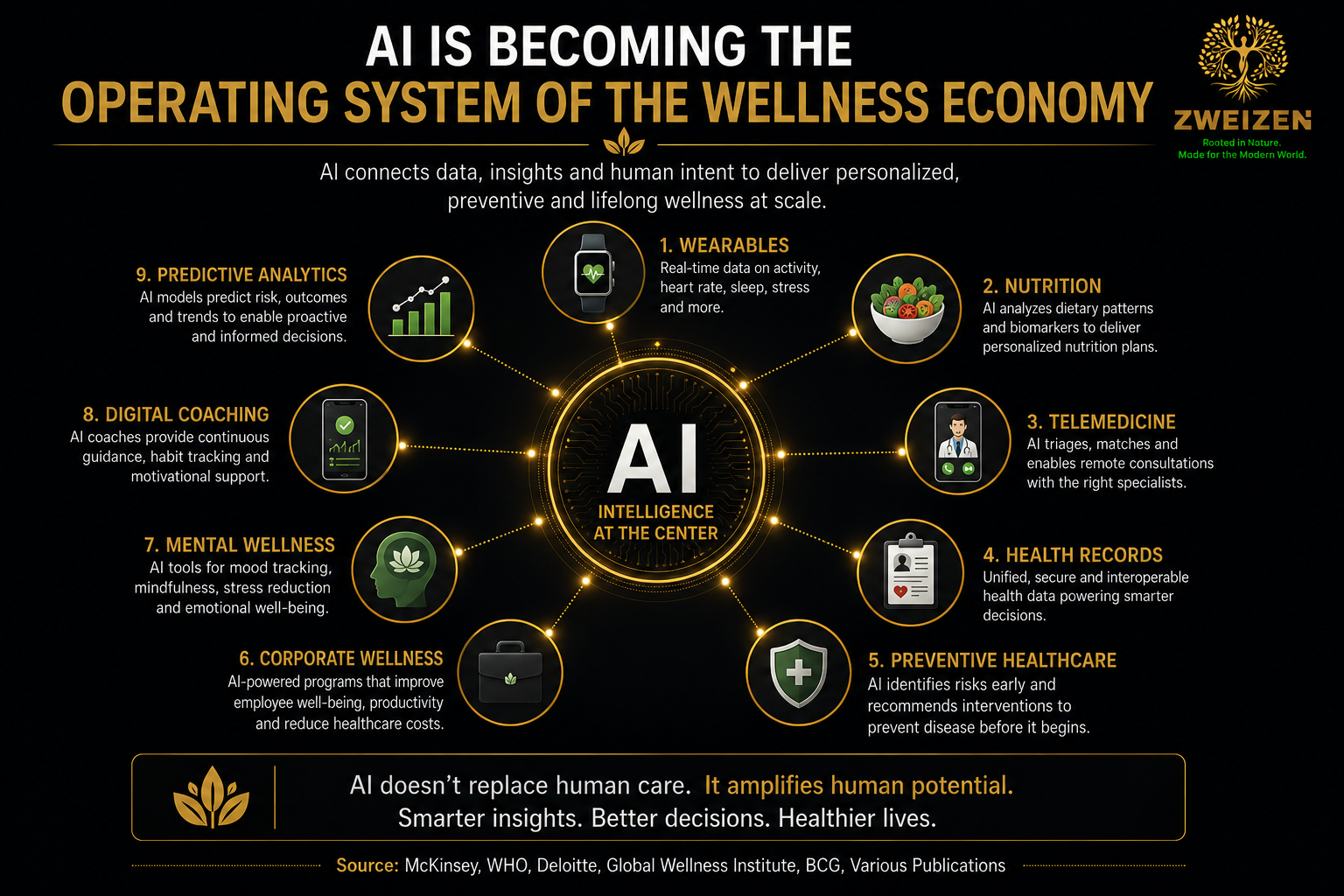
Today, Artificial Intelligence, cloud computing, wearable technology, digital health platforms, and advanced analytics are creating an entirely new ecosystem—one where health becomes more predictive, personalized, accessible, and data-driven.
The future of wellness will not be built by replacing healthcare professionals.
It will be built by empowering individuals to make better decisions before health problems become more serious.
This is one of the defining opportunities of the wellness economy.
From Reactive Healthcare to Predictive Wellness
Traditional healthcare generally begins when symptoms appear.
A patient visits a doctor.
A diagnosis is made.
Treatment begins.
Artificial Intelligence introduces another possibility.
Rather than waiting for illness, AI enables earlier insights through continuous monitoring, pattern recognition, and personalized recommendations.
This represents a transition from:
Reactive Healthcare
↓
Preventive Healthcare
↓
Predictive Wellness
Imagine a future where individuals receive reminders to improve sleep patterns, increase daily activity, manage stress, or adjust nutritional habits before lifestyle risks become more significant.
That future is already beginning to emerge.
Digital Health Is Expanding Rapidly
Digital health has become one of the fastest-growing segments within global healthcare.
It includes:
Telemedicine
Electronic Health Records (EHR)
Mobile Health Applications
Digital Therapeutics
Remote Patient Monitoring
Wearable Devices
Health Information Platforms
AI-powered Decision Support
Cloud-based Health Systems
According to the World Health Organization, digital health technologies have significant potential to improve access, efficiency, continuity of care, and health system resilience when implemented responsibly. World Health Organization – Global Strategy on Digital Health
For countries with large populations such as India, digital health also offers opportunities to improve accessibility across urban and rural communities.
Artificial Intelligence Is Personalizing Wellness
One of AI's greatest strengths is personalization.
Traditional wellness advice often follows a general approach.
Artificial Intelligence enables recommendations that consider individual differences such as:
Age
Lifestyle
Activity level
Dietary preferences
Sleep patterns
Fitness goals
Behavioural trends
Health history (where appropriate and privacy-compliant)
Instead of receiving identical recommendations, individuals increasingly expect guidance tailored to their personal circumstances.
This shift is influencing consumer expectations across the wellness industry.
Wearable Technology Is Creating Continuous Health Awareness
Only a decade ago, many people measured their health during annual medical examinations.
Today, wearable devices provide continuous awareness of daily behaviour.
Modern smartwatches and fitness trackers can monitor:
Daily movement
Heart rate
Sleep duration
Exercise consistency
Stress indicators
Activity trends
These technologies are not intended to replace professional medical evaluation.
Their greatest contribution is encouraging healthier habits through greater awareness.
When individuals understand their own behaviour, they are often better equipped to make informed lifestyle decisions.
Telemedicine Is Redefining Access
Healthcare accessibility remains a challenge across many regions of the world.
Digital consultation platforms have significantly expanded access by allowing patients to connect with healthcare professionals remotely.
Telemedicine offers several advantages:
Reduced travel time
Improved rural accessibility
Faster consultations
Follow-up continuity
Digital prescriptions
Specialist access
The COVID-19 pandemic accelerated adoption globally, and telemedicine continues to play an increasingly important role within modern healthcare systems.
In India, initiatives under the Ayushman Bharat Digital Mission (ABDM) are helping create an interoperable digital health ecosystem that supports continuity of care and digital access. Ayushman Bharat Digital Mission
AI Is Changing Consumer Expectations
Consumers no longer expect businesses merely to sell products.
They increasingly expect intelligent experiences.
Health applications recommend healthier routines.
Fitness platforms personalize training.
Nutrition applications suggest dietary improvements.
Digital coaching supports behavioural change.
Consumers increasingly value businesses that help them make informed decisions rather than simply offering products.
This transition from product-focused business models to experience-driven ecosystems represents one of the most important developments within the wellness economy.
India's Opportunity in AI-Powered Wellness
India occupies a unique position at the intersection of healthcare and technology.
The country possesses:
One of the world's largest software engineering communities.
A rapidly expanding Artificial Intelligence ecosystem.
Strong pharmaceutical manufacturing capabilities.
Growing digital infrastructure.
Government-supported digital health initiatives.
Traditional wellness systems including Ayurveda and Yoga.
This combination creates opportunities few countries can replicate.
Imagine integrating:
Artificial Intelligence.
Digital Health Records.
Preventive Wellness.
Wearable Technology.
Personalized Nutrition.
Ayurveda.
Telemedicine.
Population-scale digital infrastructure.
Together, these capabilities could position India as one of the world's leading innovation hubs for preventive wellness.
The Business Opportunity
Artificial Intelligence is not creating a single new industry.
It is transforming existing ones.
Within wellness, opportunities include:
AI-powered nutrition coaching.
Digital preventive health platforms.
Remote wellness monitoring.
Corporate wellness analytics.
Health education platforms.
Personalized supplement recommendations.
Sleep optimization technologies.
Mental wellness applications.
Behavioural coaching.
Health risk assessment tools.
Each represents an opportunity for entrepreneurs to build scalable, technology-enabled businesses.
Responsible Innovation Matters
With greater technological capability comes greater responsibility.
Health-related information is among the most sensitive forms of personal data.
Organizations developing AI-powered wellness solutions must prioritize:
Privacy.
Cybersecurity.
Transparency.
Ethical AI.
Regulatory compliance.
Human oversight.
Consumers increasingly expect companies to explain how health information is collected, stored, and used.
Trust will determine long-term adoption.
Technology alone is never enough.
AI Will Not Replace Human Care
A common misconception is that Artificial Intelligence will replace healthcare professionals.
The more realistic future is collaboration.
AI excels at:
Processing large volumes of information.
Identifying patterns.
Supporting decision-making.
Automating repetitive tasks.
Healthcare professionals provide:
Clinical judgment.
Human empathy.
Context.
Ethical decision-making.
Patient relationships.
The future of wellness combines both.
Technology enhances human expertise rather than replacing it.
The Next Decade Will Belong to Intelligent Wellness
By 2035, wellness will become increasingly integrated into everyday life.
Consumers may interact with connected ecosystems that combine wearable devices, digital health records, AI-driven recommendations, preventive lifestyle guidance, nutrition, mental wellness, and professional healthcare support.
The organizations leading this transformation will not necessarily be those with the most advanced algorithms.
They will be those capable of combining innovation with trust.
Because in healthcare and wellness, technology can improve efficiency.
Only trust creates lasting relationships.
Key Insights
Artificial Intelligence is accelerating the shift from reactive healthcare to predictive wellness.
Digital health platforms are improving accessibility, personalization, and continuity of care.
Wearable technology is increasing health awareness through real-time lifestyle insights.
India has significant opportunities to become a global leader in AI-enabled wellness by combining digital innovation with traditional wellness expertise.
The future belongs to organizations that balance innovation with ethics, privacy, scientific credibility, and responsible governance.
Technology may shape the future of wellness—but trust will determine who leads it.
Frequently Asked Questions (AI, Digital Health & Innovation)
What is digital health?
Digital health refers to the use of digital technologies—including telemedicine, mobile health apps, electronic health records, wearable devices, and AI—to support healthcare delivery, wellness, and health management.
How is AI changing preventive healthcare?
AI helps analyze health data, recognize patterns, personalize wellness recommendations, and support earlier interventions. It complements healthcare professionals rather than replacing them.
Will AI replace doctors?
No. AI is designed to assist clinicians by improving efficiency and decision support. Diagnosis, treatment decisions, and patient care continue to require qualified healthcare professionals.
Why are wearable devices important?
Wearables help individuals monitor daily activity, sleep, heart rate, and exercise consistency, encouraging greater awareness of lifestyle habits.
Why is India well positioned in AI-powered wellness?
India combines a strong technology ecosystem, expanding digital health infrastructure, pharmaceutical manufacturing expertise, government initiatives such as ABDM, and globally recognized wellness traditions like Ayurveda and Yoga, creating a unique environment for innovation.
Investment & Startup Landscape
Why Capital Is Flowing Into the Wellness Economy—and What It Means for Entrepreneurs
Economic transformations create new industries.
New industries attract entrepreneurs.
Entrepreneurs attract investors.
This cycle has repeated throughout modern history.
The internet created global technology companies.
Smartphones accelerated the app economy.
Cloud computing transformed enterprise software.
Artificial Intelligence is now reshaping productivity across every sector.
The wellness economy is following a similar trajectory.
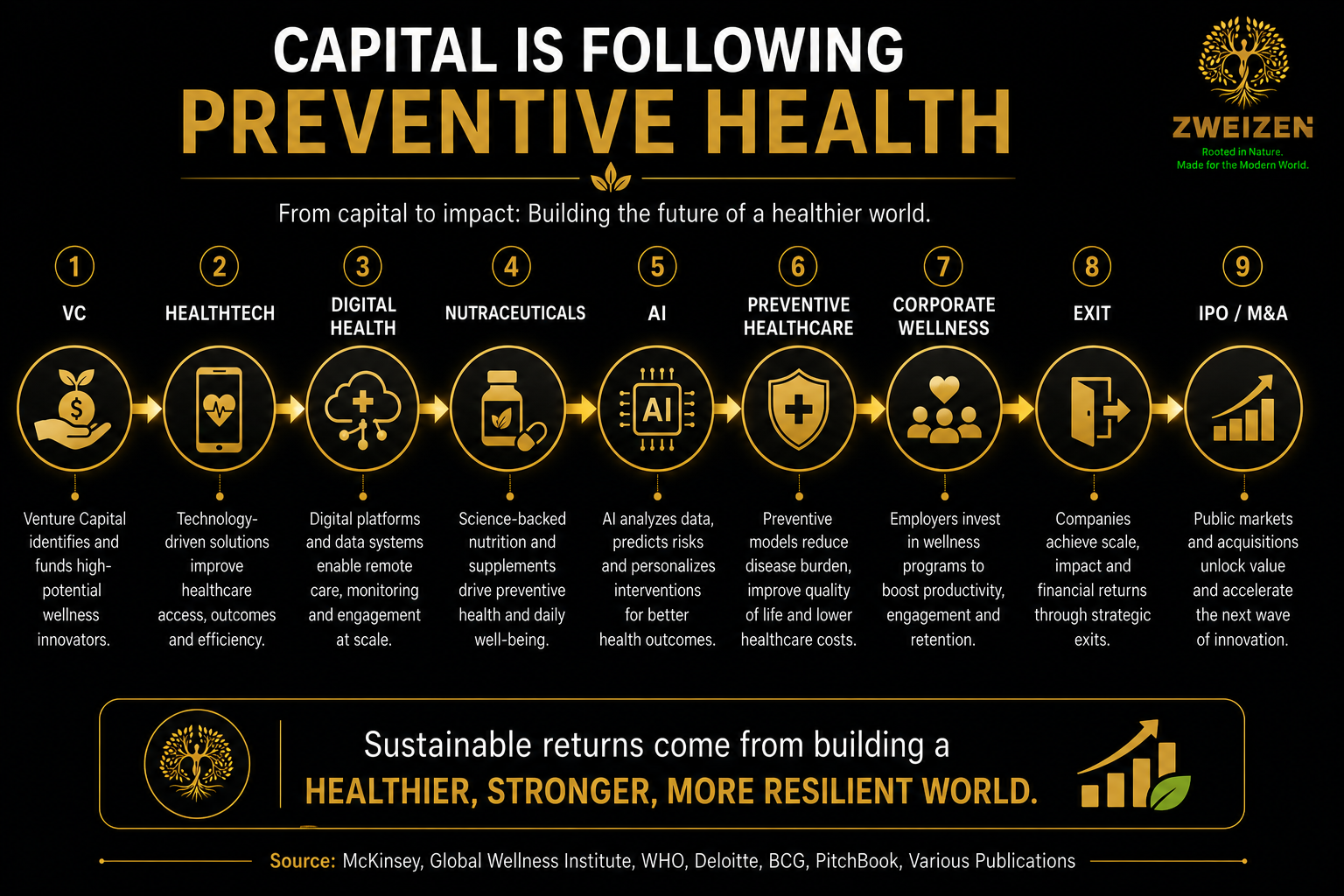
What began as a collection of independent industries has evolved into one of the world's largest economic ecosystems. Investors, venture capital firms, private equity funds, family offices, and corporate investment arms increasingly view wellness as a long-term structural opportunity rather than a short-term consumer trend.
For entrepreneurs, this represents one of the most significant business opportunities of the coming decade.
Why Investors Are Paying Attention
Professional investors rarely allocate capital based solely on consumer trends.
They invest where long-term demand is supported by powerful structural drivers.
The wellness economy meets many of those criteria.
Global populations are ageing.
Healthcare expenditure continues to increase.
Consumers are becoming more health-conscious.
Technology is making healthcare more accessible.
Artificial Intelligence is enabling personalized wellness.
Governments are investing in preventive healthcare.
Consumer spending on health and well-being continues to rise across developed and emerging economies.
According to the Global Wellness Institute, the wellness economy is projected to grow from US$6.8 trillion in 2024 to approximately US$9.8 trillion by 2029, making it one of the fastest-growing sectors globally. Global Wellness Institute – 2025 Global Wellness Economy Monitor
For investors, this represents a market supported by long-term demographic and behavioural change rather than temporary demand cycles.
Capital Is Moving Toward Prevention
Historically, healthcare investment focused primarily on hospitals, pharmaceuticals, diagnostics, and medical devices.
Today, investment is expanding into preventive wellness.
Funding increasingly supports companies working in:
Digital health.
Health technology.
Preventive healthcare platforms.
Personalized nutrition.
Wearable technology.
Mental wellness.
Women's health.
Healthy ageing.
Corporate wellness.
Digital therapeutics.
AI-powered healthcare solutions.
Consumers are no longer purchasing healthcare only after becoming ill.
They increasingly invest before illness occurs.
Capital follows that behavioural shift.
Venture Capital Sees a Long-Term Opportunity
Venture capital firms generally seek businesses capable of delivering sustained growth over many years.
The wellness economy offers several characteristics that align with venture investment principles.
Large addressable markets.
Recurring customer relationships.
Technology integration.
Subscription-based business models.
Scalable digital platforms.
Growing global demand.
Strong demographic support.
Cross-border expansion opportunities.
Many wellness companies are no longer product businesses alone.
They are becoming technology-enabled ecosystems.
That evolution significantly increases long-term enterprise value.
India's Startup Ecosystem Is Entering a New Phase
India has emerged as the third-largest startup ecosystem in the world, with more than 100,000 DPIIT-recognized startups across sectors including healthcare, biotechnology, artificial intelligence, fintech, agritech, and wellness. Government initiatives such as Startup India continue to encourage innovation, entrepreneurship, and investment. Startup India
Within this ecosystem, wellness startups are expanding rapidly.
Entrepreneurs are developing solutions in:
Digital consultations.
Fitness technology.
Nutrition platforms.
Preventive healthcare.
Corporate wellness.
Health education.
Women's wellness.
Healthy ageing.
Remote patient monitoring.
Artificial Intelligence.
These businesses increasingly combine healthcare expertise with software, analytics, and consumer technology.
The Rise of HealthTech
HealthTech has become one of the most dynamic segments within India's innovation ecosystem.
Several trends are driving this growth.
Rapid smartphone adoption.
Affordable internet access.
Digital payment infrastructure.
Government-backed digital health initiatives.
Increasing healthcare awareness.
Artificial Intelligence.
Cloud computing.
Telemedicine.
These factors allow startups to scale much faster than traditional healthcare businesses.
Instead of building physical infrastructure in every city, digital platforms can reach millions of users through mobile applications and cloud-based services.
This dramatically changes the economics of healthcare delivery.
Corporate Venture Capital Is Entering Wellness
Investment is no longer limited to venture capital funds.
Large corporations increasingly invest in wellness innovation through:
Corporate venture capital.
Strategic partnerships.
Innovation labs.
Accelerator programmes.
Research collaborations.
Joint ventures.
Companies recognize that wellness directly influences consumer engagement, employee productivity, and long-term brand value.
As a result, innovation increasingly occurs through collaboration rather than competition.
Mergers and Acquisitions Are Accelerating
As industries mature, mergers and acquisitions become more common.
The wellness economy is following this pattern.
Large healthcare companies increasingly acquire:
Digital health platforms.
Nutrition companies.
Fitness applications.
Preventive healthcare technologies.
Artificial Intelligence startups.
Consumer wellness brands.
These acquisitions enable established organizations to accelerate innovation while allowing startups to scale globally.
For entrepreneurs, acquisition represents one possible pathway alongside independent growth and public market listings.
The IPO Opportunity
Global capital markets are becoming increasingly receptive to companies focused on long-term health and wellness.
Public investors now evaluate businesses based not only on current profitability but also on:
Market size.
Consumer retention.
Technology.
Brand trust.
Recurring revenue.
Governance.
Innovation.
Companies capable of demonstrating sustainable growth and responsible leadership are better positioned to access long-term capital.
The Business Models Investors Prefer
Although every company is unique, investors increasingly favour wellness businesses that demonstrate:
Strong scientific credibility.
Clear regulatory compliance.
Recurring customer engagement.
Scalable technology.
Data-driven decision making.
High customer retention.
Transparent governance.
Global expansion potential.
Sustainable competitive advantages.
The era of building businesses solely around aggressive marketing is fading.
Investors increasingly seek organizations capable of creating enduring value.
Funding Alone Does Not Build Great Companies
Entrepreneurs often assume that capital is the primary factor behind successful startups.
Experience suggests otherwise.
Funding accelerates execution.
It does not replace execution.
History shows numerous examples of highly funded companies that failed because they lacked:
Product-market fit.
Consumer trust.
Operational discipline.
Regulatory compliance.
Financial governance.
Long-term vision.
The wellness economy rewards businesses that solve genuine problems rather than simply attracting investment.
Corporate Governance Will Become a Competitive Advantage
As wellness companies grow, governance becomes increasingly important.
Investors carefully evaluate:
Board structure.
Financial transparency.
Risk management.
Quality systems.
Regulatory compliance.
Ethical leadership.
Data privacy.
Supply-chain integrity.
Strong governance reduces risk while strengthening investor confidence.
In industries influencing human health, governance is not merely a legal requirement.
It is a business advantage.
The Founder Mindset Must Evolve
Building a wellness company requires more than developing products.
Founders increasingly need expertise across:
Science.
Technology.
Operations.
Compliance.
Brand building.
Corporate governance.
Data security.
Customer education.
Global regulations.
The most successful founders of the next decade will think beyond individual products.
They will build integrated ecosystems capable of creating lasting trust.
What This Means for Zweizen
As Founder and CEO of Zweizen, I believe the future of wellness companies will be determined not by how many products they launch, but by how effectively they build trust, educate consumers, embrace innovation, and maintain uncompromising quality.
Our ambition extends beyond manufacturing wellness products.
We aspire to contribute to a responsible ecosystem where education, preventive health, scientific integrity, and ethical business practices work together.
That vision reflects the broader direction of the wellness economy itself.
Key Insights
Investment follows long-term structural change—not short-term trends.
The wellness economy offers one of the world's largest and fastest-growing opportunities for entrepreneurs and investors.
India's startup ecosystem provides a strong foundation for innovation in preventive healthcare, digital health, AI, and wellness technologies.
Technology, governance, and scientific credibility will increasingly determine which companies succeed.
The future belongs to founders who build trust before scale and value before valuation.
Frequently Asked Questions (Investment & Startup Landscape)
Why are investors interested in the wellness economy?
Because it combines strong demographic trends, recurring consumer demand, digital innovation, and a large global addressable market with long-term growth potential.
Is wellness a good sector for startups?
Yes. Areas such as digital health, preventive healthcare, AI-powered wellness, personalized nutrition, women's health, healthy ageing, and corporate wellness continue to attract entrepreneurial activity and investor interest.
Why is India attractive for wellness businesses?
India combines a large domestic market, globally recognized wellness traditions, pharmaceutical manufacturing capabilities, digital infrastructure, government support, and one of the world's largest startup ecosystems.
What do investors expect from wellness startups?
They look for strong governance, regulatory compliance, product quality, scientific credibility, scalable business models, recurring revenue, customer trust, and experienced leadership.
What is the biggest challenge for wellness startups?
Scaling responsibly while maintaining quality, transparency, compliance, and consumer trust.
Challenges, Governance & Trust
Why Credibility Will Become the Greatest Competitive Advantage in the Wellness Economy
Every rapidly growing industry eventually reaches a defining moment.
During its early years, innovation drives expansion.
Entrepreneurs introduce new ideas.
Investors provide capital.
Consumers embrace new products and services.
Markets grow rapidly.
However, as industries mature, another factor becomes increasingly important.
Trust.
The global wellness economy is approaching that stage.
While innovation continues to reshape healthcare, nutrition, digital health, preventive wellness, and consumer products, long-term success will increasingly depend not on who grows the fastest, but on who earns and maintains public confidence.
For CEOs, founders, investors, and policymakers, governance is no longer a compliance requirement.
It is becoming a strategic business asset.
A Growing Industry Brings Greater Responsibility
As the wellness economy expands, so does public scrutiny.
Consumers are becoming more informed.
Regulators are strengthening oversight.
Investors are demanding greater transparency.
Healthcare professionals expect stronger scientific evidence.
Digital platforms are increasingly reviewing health-related claims.
The result is clear.
The standards for operating a successful wellness business are becoming significantly higher than they were a decade ago.
Growth without governance is no longer sustainable.
Companies must demonstrate that they deserve public trust.
The Trust Deficit
One of the biggest challenges facing the global wellness industry is misinformation.
The rapid growth of social media has enabled health information to reach millions of people within minutes.
Unfortunately, misinformation spreads just as quickly.
Consumers frequently encounter:
Exaggerated marketing claims.
Misleading advertisements.
Unverified testimonials.
Unsubstantiated "miracle" solutions.
Conflicting health advice.
Pseudoscientific recommendations.
These practices create confusion.
More importantly, they reduce confidence in responsible businesses that invest in quality, research, and compliance.
According to the World Health Organization, health misinformation can negatively influence public health decisions and has become an important global challenge requiring coordinated action. World Health Organization – Infodemic Management
For responsible companies, combating misinformation is no longer optional.
It is part of building a sustainable brand.
Scientific Credibility Matters More Than Marketing
Modern consumers increasingly question health claims.
Before purchasing a wellness product or service, many consumers now:
Read product labels.
Compare ingredients.
Review certifications.
Research scientific evidence.
Watch expert discussions.
Read customer reviews.
Evaluate brand reputation.
This shift is changing the role of marketing.
The most successful wellness brands of the future will not simply communicate benefits.
They will explain evidence.
They will educate consumers.
They will acknowledge limitations where appropriate.
They will prioritize transparency over exaggeration.
Scientific credibility has become one of the strongest drivers of long-term brand value.
Corporate Governance Is No Longer Optional
Historically, corporate governance was often associated with publicly listed companies and financial institutions.
Today, governance has become equally important for startups, family businesses, digital platforms, healthcare companies, and wellness brands.
Investors increasingly evaluate organizations based on:
Leadership accountability.
Board oversight.
Financial transparency.
Risk management.
Regulatory compliance.
Ethical decision-making.
Internal controls.
Supply-chain governance.
Data security.
Corporate governance is not merely about reducing legal risk.
It improves operational discipline.
It strengthens investor confidence.
It enhances organizational resilience.
Most importantly, it demonstrates that a company is prepared for sustainable growth.
Product Quality Defines Brand Reputation
In the wellness industry, product quality directly influences consumer trust.
Quality begins long before a product reaches the customer.
It starts with:
Responsible sourcing.
Ingredient verification.
Manufacturing standards.
Quality assurance.
Testing procedures.
Packaging integrity.
Storage conditions.
Distribution practices.
Companies that consistently invest in quality systems build stronger reputations over time.
Conversely, a single quality failure can damage years of brand building.
For this reason, internationally recognized standards such as Good Manufacturing Practices (GMP), ISO quality management systems, and applicable regulatory requirements have become increasingly important for organizations operating within the wellness sector.
Quality is not simply an operational function.
It is a strategic investment.
Responsible Communication Builds Long-Term Value
Communication has become one of the most important responsibilities of wellness businesses.
Consumers deserve accurate, balanced, and evidence-informed information.
Responsible communication means avoiding exaggerated promises.
It means explaining what products are designed to support without implying outcomes that have not been established.
It means encouraging consumers to consult qualified healthcare professionals whenever appropriate.
Trust is strengthened when companies communicate honestly.
Responsible communication may generate slower short-term growth than sensational marketing.
However, it creates stronger customer relationships over the long term.
Data Privacy in the Digital Wellness Era
As Artificial Intelligence, wearable devices, and digital health platforms become more common, organizations collect increasing amounts of personal information.
Health-related data is among the most sensitive categories of personal information.
Consumers expect organizations to protect it responsibly.
Businesses must therefore prioritize:
Cybersecurity.
Data encryption.
Privacy by design.
Transparent consent.
Responsible data governance.
Regulatory compliance.
Failure to protect consumer information can result in legal consequences, financial loss, and reputational damage.
In the digital economy, protecting data is inseparable from protecting trust.
Regulatory Compliance Is Becoming a Competitive Advantage
Regulations are often viewed as barriers to business.
In reality, effective regulation creates confidence.
Strong regulatory frameworks help:
Protect consumers.
Encourage responsible innovation.
Improve product quality.
Reduce misinformation.
Strengthen international trade.
Increase investor confidence.
Companies that integrate compliance into their business strategy often expand more successfully into global markets.
Compliance should therefore be viewed not as a cost but as an investment in long-term credibility.
ESG and Responsible Business Leadership
Environmental, Social, and Governance (ESG) considerations are increasingly influencing investment decisions.
Institutional investors, financial institutions, and multinational corporations increasingly evaluate organizations based not only on financial performance but also on how responsibly they operate.
Within the wellness industry, ESG principles include:
Responsible sourcing.
Ethical manufacturing.
Environmental sustainability.
Employee well-being.
Community impact.
Board accountability.
Transparent governance.
Companies that align commercial success with responsible business practices are often better positioned to attract long-term investors and strategic partners.
Leadership Will Define the Winners
Technology can be copied.
Products can be replicated.
Marketing strategies can be imitated.
Trust cannot.
Trust is earned through consistent decisions over many years.
It is built when organizations place consumers before short-term revenue.
It grows when leaders accept responsibility.
It strengthens when businesses remain transparent during both success and adversity.
The wellness economy will reward organizations that consistently demonstrate integrity.
Leadership will therefore become one of the industry's most valuable competitive advantages.
The Future Belongs to Trusted Brands
The next generation of global wellness companies will not necessarily be the largest.
They will be the most trusted.
Consumers will increasingly choose brands that demonstrate:
Scientific integrity.
Transparent communication.
Reliable quality.
Ethical leadership.
Strong governance.
Responsible innovation.
Long-term commitment to consumer well-being.
Trust will become the foundation upon which sustainable growth is built.
Key Insights
The greatest challenge facing the wellness economy is not market demand.
It is maintaining public confidence as the industry expands.
Corporate governance, scientific credibility, responsible communication, product quality, and ethical leadership will increasingly determine long-term success.
Organizations that treat trust as a strategic asset rather than a marketing slogan will be best positioned to lead the global wellness economy.
Frequently Asked Questions
Why is trust so important in the wellness industry?
Because wellness products and services directly relate to people's health. Consumers expect accurate information, responsible communication, quality standards, and ethical business practices before making purchasing decisions.
What role does corporate governance play in wellness companies?
Corporate governance strengthens accountability, transparency, regulatory compliance, investor confidence, and long-term sustainability. It helps organizations manage growth responsibly.
Why is scientific credibility becoming more important?
Consumers increasingly research products before purchasing. Companies that support their communication with credible evidence and transparent information are more likely to earn long-term trust.
How can wellness companies build stronger consumer confidence?
By investing in quality manufacturing, transparent labeling, responsible communication, regulatory compliance, customer education, and consistent ethical leadership.
What is the biggest long-term risk facing the wellness economy?
The spread of misinformation and exaggerated health claims. These practices can reduce public confidence across the entire industry, making trust and governance critical competitive advantages.
The Future of Wellness (2026–2035)
The Next Decade Will Not Be Defined by Healthcare Alone—It Will Be Defined by Human Well-Being
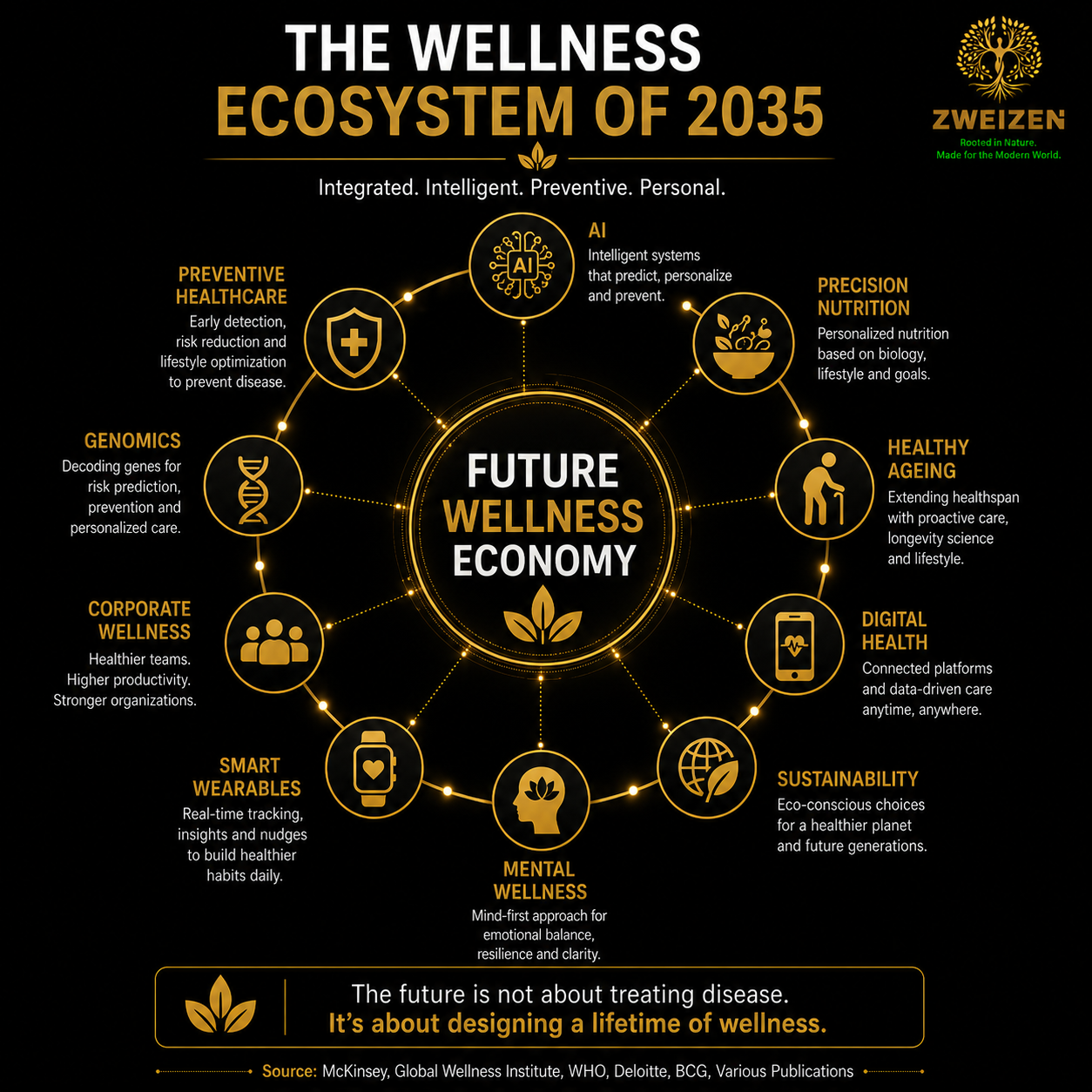
Every decade creates industries that redefine the global economy.
The coming decade will be remembered not only for Artificial Intelligence, robotics, quantum computing, or clean energy, but also for a profound transformation in how societies approach health.
The wellness economy is entering its next phase.
The first phase focused primarily on awareness.
Consumers began adopting healthier lifestyles.
The second phase emphasized accessibility.
Digital platforms, wearable devices, and preventive healthcare became more widely available.
The third phase—already beginning—will be defined by intelligence, personalization, trust, and integration.
Between 2026 and 2035, wellness will become less about individual products and more about connected ecosystems that support healthier lives.
This transition represents one of the greatest business opportunities of the decade.
Wellness Will Become Increasingly Personalized
The traditional approach to wellness has largely been standardized.
General dietary advice.
Generic fitness plans.
Standard supplement recommendations.
Uniform workplace wellness programs.
The future will be very different.
Advances in Artificial Intelligence, health analytics, wearable technology, genomics, and digital platforms are making personalized wellness increasingly practical.
Consumers will expect recommendations tailored to their:
Lifestyle.
Age.
Dietary preferences.
Activity patterns.
Sleep quality.
Stress levels.
Personal health goals.
Rather than searching for information themselves, individuals will increasingly expect intelligent systems to provide relevant, evidence-informed guidance.
Personalization will become the standard rather than a premium service.
Healthy Ageing Will Become a Global Economic Priority
One of the defining demographic trends of the coming decade is population ageing.
According to the United Nations, by 2050, one in six people globally will be over the age of 65, compared with one in eleven in 2019. This demographic transition will significantly influence healthcare, financial planning, housing, workforce participation, and consumer markets. United Nations – World Population Ageing
Longer life expectancy creates an important challenge.
Living longer is valuable.
Living healthier for longer is even more important.
This shift is increasing interest in:
Preventive nutrition.
Mobility.
Brain health.
Sleep quality.
Physical activity.
Mental well-being.
Social engagement.
Healthy ageing will become one of the fastest-growing segments of the wellness economy.
Artificial Intelligence Will Become an Everyday Wellness Partner
Artificial Intelligence will increasingly move beyond hospitals and research laboratories into everyday life.
Instead of simply answering questions, future AI systems may assist individuals by:
Supporting healthier daily routines.
Encouraging physical activity.
Improving sleep habits.
Providing educational health content.
Monitoring long-term behavioural patterns.
Helping users understand wellness information more effectively.
The value of AI will not lie solely in automation.
Its greatest contribution will be supporting better human decisions.
However, AI must remain transparent, privacy-conscious, and responsibly governed to maintain public trust.
Nutrition Will Become More Scientific
Consumers are becoming increasingly interested in understanding how nutrition influences long-term well-being.
Future developments are expected to include:
Personalized nutrition.
Functional foods.
Evidence-informed botanical ingredients.
Plant-based innovation.
Digital dietary coaching.
Nutritional analytics.
Rather than following general dietary trends, consumers will increasingly seek recommendations aligned with their individual goals and preferences.
This creates significant opportunities for innovation across agriculture, food technology, biotechnology, and preventive wellness.
Mental Well-Being Will Become a Strategic Priority
For many years, mental well-being was often discussed separately from business strategy.
That distinction is disappearing.
Organizations increasingly recognize that mental well-being influences:
Leadership performance.
Innovation.
Decision-making.
Employee engagement.
Customer experience.
Workplace culture.
Long-term organizational resilience.
Future business strategies will increasingly integrate physical and mental well-being as complementary priorities rather than separate initiatives.
Digital Health Ecosystems Will Replace Fragmented Solutions
Today's healthcare systems often operate through disconnected platforms.
Medical records.
Insurance.
Wearable devices.
Fitness applications.
Nutrition platforms.
Healthcare providers.
These systems frequently function independently.
The future will increasingly favour connected ecosystems.
Consumers will expect seamless experiences that integrate health information securely while enabling more coordinated preventive care.
Governments around the world are investing in digital health infrastructure to improve continuity of care, interoperability, and accessibility.
India's Ayushman Bharat Digital Mission (ABDM) represents an important example of this long-term direction. Ayushman Bharat Digital Mission
Sustainability and Wellness Will Become Interconnected
Future consumers will increasingly recognize that personal health and environmental sustainability are closely connected.
Demand is expected to increase for:
Responsible sourcing.
Environmentally conscious manufacturing.
Reduced packaging waste.
Plant-based innovation.
Transparent supply chains.
Ethically produced wellness products.
Organizations capable of combining environmental responsibility with consumer well-being will strengthen long-term competitiveness.
India's Opportunity Between 2026 and 2035
India enters this decade with extraordinary advantages.
A young population.
Global recognition in Ayurveda and Yoga.
A rapidly growing digital economy.
Strong pharmaceutical manufacturing.
Expanding HealthTech innovation.
Government support through initiatives such as the Ministry of AYUSH, Digital India, Startup India, and the Ayushman Bharat Digital Mission.
Growing international demand for preventive wellness.
These strengths provide India with an opportunity that extends beyond exports.
India can become a global centre for:
Preventive healthcare innovation.
Digital wellness platforms.
Evidence-informed Ayurveda.
Artificial Intelligence in wellness.
Nutraceutical research.
Health education.
Global wellness entrepreneurship.
Realizing this opportunity will require sustained investment in research, quality, governance, international collaboration, and scientific validation.
What CEOs Should Prepare For
The coming decade will require a broader definition of business leadership.
Organizations should begin preparing now by asking strategic questions.
How will changing consumer expectations influence our industry?
Can preventive wellness become part of our long-term strategy?
Are we investing sufficiently in employee well-being?
How will Artificial Intelligence reshape customer experiences?
Do our governance systems support long-term trust?
Are we prepared for increasing regulatory expectations?
How can our organization contribute positively to society while creating sustainable shareholder value?
These questions extend beyond healthcare.
They apply to every sector.
The Wellness Economy of 2035
By 2035, the wellness economy will likely look very different from today.
Consumers will increasingly expect:
Personalized wellness.
Connected digital ecosystems.
Preventive healthcare.
Responsible Artificial Intelligence.
Evidence-informed products.
Transparent supply chains.
Stronger corporate governance.
Healthier workplaces.
Sustainable manufacturing.
Trusted brands.
The organizations leading this future will not necessarily be those with the largest advertising budgets.
They will be those that consistently earn trust through responsible innovation.
A Defining Decade for Business
History rarely announces transformational moments while they are happening.
They become obvious only in retrospect.
The organizations that invested early in digital technology became industry leaders.
The companies embracing Artificial Intelligence today are positioning themselves for tomorrow.
The same principle applies to the wellness economy.
Its influence will continue expanding because it reflects enduring human priorities rather than temporary market trends.
Health.
Quality of life.
Longevity.
Productivity.
Purpose.
Trust.
These priorities will remain relevant regardless of economic cycles.
For business leaders, the question is no longer whether the wellness economy will influence the future.
The question is whether organizations are prepared to lead within it.
Key Insights
The future of wellness will be driven by personalization, Artificial Intelligence, healthy ageing, digital ecosystems, sustainability, and consumer trust.
India has the potential to become one of the world's leading innovation hubs by combining traditional wellness knowledge with modern science and technology.
The next decade will reward organizations that prioritize long-term value creation, ethical leadership, and evidence-informed innovation over short-term market gains.
Ultimately, the future of the wellness economy will not be determined by the products companies sell.
It will be determined by the positive impact they create in people's lives.
Frequently Asked Questions
What will shape the wellness economy between 2026 and 2035?
The most significant drivers include Artificial Intelligence, personalized wellness, healthy ageing, digital health ecosystems, preventive healthcare, sustainability, and increasing consumer demand for trusted, evidence-informed products and services.
Will Artificial Intelligence replace healthcare professionals?
No. AI will enhance healthcare by supporting decision-making, education, and preventive wellness, while qualified healthcare professionals will continue to provide clinical expertise, diagnosis, and treatment.
Why is healthy ageing becoming such an important market?
People are living longer than ever before. The focus is shifting from simply increasing lifespan to improving healthspan—the number of years people live in good health and maintain independence.
Why is India well positioned to lead the future of wellness?
India combines globally recognized wellness traditions, a large and youthful workforce, pharmaceutical manufacturing strength, digital innovation, government support, and a rapidly growing startup ecosystem.
What should CEOs prioritize over the next decade?
Business leaders should invest in preventive health strategies, responsible AI adoption, employee well-being, governance, scientific credibility, sustainability, and customer trust to remain competitive in the evolving wellness economy.
The Wellness Economy Is Not Just Changing Healthcare—It Is Redefining Business Leadership
Every significant economic transformation begins with a fundamental shift in how society thinks.
The Industrial Revolution changed how the world produced goods.
The digital revolution changed how people communicated and conducted business.
Artificial Intelligence is redefining how organizations innovate, automate, and make decisions.
The wellness economy is changing something even more fundamental.
It is changing how people define success.
For much of modern history, economic progress has been measured through productivity, profitability, industrial output, market capitalization, and shareholder returns. These indicators remain essential and will continue to shape business performance.
However, the twenty-first century is introducing another equally important dimension of value creation.
Human well-being.
Consumers are no longer evaluating companies solely by the products they manufacture or the services they provide.
Increasingly, they evaluate organizations by the trust they build.
The transparency they demonstrate.
The quality they maintain.
The responsibility they accept.
The positive impact they create.
This evolution represents one of the most important leadership challenges of our generation.
Wellness Is Becoming a Foundation of Economic Growth
The evidence presented throughout this article demonstrates that the wellness economy is far more than a rapidly growing industry.
It is becoming a foundational component of modern economic development.
Global consumers are prioritizing healthier lifestyles.
Governments are expanding preventive healthcare initiatives.
Employers increasingly recognize that employee well-being influences productivity, innovation, and organizational resilience.
Technology companies continue investing in Artificial Intelligence, digital health, and connected wellness ecosystems.
Investors increasingly allocate capital toward businesses aligned with long-term demographic and behavioural trends.
Together, these developments indicate that wellness is becoming deeply integrated into the future of global commerce.
This transformation is unlikely to slow.
The structural forces driving it—ageing populations, urbanisation, lifestyle changes, technological innovation, rising healthcare expenditure, and increasing consumer awareness—will continue influencing markets for decades.
The organizations that recognize these trends today will be better prepared to compete tomorrow.
Every Industry Has a Role to Play
One of the most important conclusions emerging from this research is that the wellness economy is not limited to healthcare companies.
Technology companies can improve digital health accessibility.
Food manufacturers can develop healthier nutritional solutions.
Financial institutions can support wellness-focused financial products and insurance innovation.
Real estate developers can design healthier communities.
Educational institutions can promote health literacy.
Employers can invest in healthier workplaces.
Manufacturers can strengthen quality systems and sustainability.
Retail businesses can improve transparency and consumer education.
Every industry has an opportunity to contribute.
The wellness economy is therefore not defined by a specific product category.
It is defined by a broader commitment to improving quality of life.
India's Defining Opportunity
India stands at a remarkable point in its economic journey.
The country possesses many of the ingredients required to become a global leader in preventive wellness.
A young and dynamic population.
Globally respected wellness traditions.
A strong pharmaceutical and nutraceutical manufacturing ecosystem.
Rapid digital transformation.
Artificial Intelligence capabilities.
Government initiatives supporting healthcare modernization.
A thriving entrepreneurial ecosystem.
Growing international recognition.
However, leadership will not be achieved through heritage alone.
It will depend upon the ability to combine traditional knowledge with modern scientific research.
To embrace innovation while maintaining quality.
To expand globally while strengthening governance.
To scale responsibly without compromising trust.
If India succeeds in achieving this balance, it will not merely participate in the global wellness economy.
It will help define its future.
The Future Will Reward Responsible Leadership
The next decade will challenge business leaders in new ways.
Organizations will be expected to innovate more rapidly.
Adopt Artificial Intelligence responsibly.
Protect consumer data.
Maintain regulatory compliance.
Reduce environmental impact.
Strengthen corporate governance.
Build resilient supply chains.
Communicate transparently.
Consumers will increasingly support businesses that demonstrate authenticity rather than exaggerated promises.
Investors will continue rewarding companies capable of creating sustainable long-term value.
Employees will increasingly choose organizations that genuinely care about well-being.
In this environment, leadership itself becomes a competitive advantage.
The businesses that succeed will not simply respond to changing expectations.
They will help shape them.
A New Definition of Success
Perhaps the greatest lesson of the wellness economy is that success is no longer measured solely by financial performance.
Revenue matters.
Profitability matters.
Innovation matters.
Investment matters.
Yet lasting business success increasingly depends upon another question.
Does the organization improve people's lives?
Companies that answer this question positively are more likely to build stronger brands, deeper customer relationships, resilient workforces, loyal investors, and sustainable long-term growth.
The future belongs to businesses that recognize that commercial success and social value are not competing objectives.
They are increasingly inseparable.
Looking Beyond 2035
No one can predict the future with complete certainty.
However, history provides an important lesson.
Organizations that recognize structural transformations before they become obvious often become the leaders of the next generation.
The wellness economy represents one of those transformations.
It is supported by demographic trends.
Technological innovation.
Changing consumer behaviour.
Preventive healthcare.
Artificial Intelligence.
Digital health.
Healthy ageing.
Sustainability.
Global collaboration.
These forces will continue shaping business decisions well beyond 2035.
The opportunity therefore extends far beyond the current market size.
It represents a new philosophy of economic development—one where healthier people create stronger organizations, stronger organizations contribute to healthier societies, and healthier societies build more resilient economies.
Final Thoughts
The wellness economy is not simply about living longer.
It is about living better.
It is not simply about selling wellness products.
It is about creating ecosystems that empower healthier decisions.
It is not simply about responding to illness.
It is about enabling prevention, education, resilience, and long-term well-being.
For CEOs, founders, investors, policymakers, healthcare professionals, and entrepreneurs, this represents an extraordinary opportunity.
Not merely to participate in one of the world's fastest-growing industries.
But to help shape a future where economic growth and human well-being advance together.
History will remember the organizations that recognized this transformation early.
The question every business leader should ask today is simple:
Will your organization simply observe the wellness economy—or will it help lead it?
CEO Perspective
Leading Beyond Products: Building Trust, Creating Value, and Shaping the Future of the Wellness Economy
When I founded Zweizen Private Limited, my ambition was never limited to launching another wellness brand.
The vision was much broader.
I wanted to contribute to a future where preventive health becomes a part of everyday life rather than an afterthought.
A future where businesses measure success not only by revenue, but also by the positive impact they create for individuals, families, communities, and society.
Throughout this article, we have explored the remarkable evolution of the global wellness economy.
We examined how consumer behaviour is changing.
How governments are investing in preventive healthcare.
How Artificial Intelligence is transforming health management.
How investors are recognising wellness as a long-term economic opportunity.
How India stands at the threshold of becoming a global leader.
Yet after analysing market reports, economic forecasts, investment trends, and technological innovations, one conclusion becomes increasingly clear.
The future of the wellness economy will not be determined solely by technology.
It will be determined by leadership.
Leadership Creates Industries
History consistently demonstrates that industries are shaped by leaders who recognise opportunities before they become obvious.
The Industrial Revolution was driven by visionary entrepreneurs who believed manufacturing could transform society.
The internet revolution was led by innovators who believed information should be universally accessible.
Artificial Intelligence is advancing because leaders recognise its potential to improve productivity, decision-making, and innovation.
The wellness economy requires the same kind of leadership.
Leadership that thinks beyond quarterly performance.
Leadership that values long-term trust over short-term attention.
Leadership that recognises health as one of humanity's most valuable assets.
Trust Will Become the World's Most Valuable Competitive Advantage
The next decade will not belong exclusively to companies with the largest advertising budgets or the fastest growth rates.
It will belong to organisations that consistently earn trust.
Trust through transparency.
Trust through quality.
Trust through responsible innovation.
Trust through scientific integrity.
Trust through ethical governance.
Trust through honest communication.
Consumers have become more informed than ever before.
Investors have become more selective.
Regulators have become more vigilant.
Healthcare professionals increasingly expect evidence-based approaches.
Employees seek organisations whose values align with their own.
In such an environment, trust becomes more valuable than attention.
Because attention can be purchased.
Trust must be earned.
Business Must Create More Than Profit
Profitability remains essential.
Without profitable businesses, innovation cannot be sustained.
Employment cannot grow.
Research cannot continue.
Investment cannot flourish.
However, the purpose of business is evolving.
The most respected organisations increasingly recognise that financial performance and societal impact can strengthen one another.
Creating healthier products.
Supporting healthier workplaces.
Investing in education.
Improving accessibility.
Strengthening sustainability.
Encouraging responsible innovation.
These are not simply social initiatives.
They are increasingly becoming strategic business advantages.
Businesses that improve people's lives create stronger customer relationships.
Stronger customer relationships create stronger brands.
Stronger brands create sustainable growth.
India's Responsibility
India has inherited one of the richest wellness traditions in human history.
Ayurveda.
Yoga.
Meditation.
Natural nutrition.
Holistic approaches to daily living.
Today, India also possesses one of the world's fastest-growing technology ecosystems.
World-class pharmaceutical manufacturing.
Artificial Intelligence expertise.
Digital public infrastructure.
Entrepreneurial talent.
A young and ambitious workforce.
This combination creates both an opportunity and a responsibility.
Our responsibility is not simply to preserve ancient knowledge.
It is to validate it through modern scientific research.
To manufacture with global quality standards.
To communicate responsibly.
To innovate ethically.
To build organisations that represent India with credibility across international markets.
The future of India's wellness leadership will depend not on history alone, but on how responsibly we shape the future.
The Role of Zweizen
At Zweizen, we believe wellness should be built on three enduring principles.
Education before promotion.
Consumers deserve knowledge before they make purchasing decisions.
Empowered consumers make better long-term choices.
Quality before scale.
Growth achieved without quality cannot be sustained.
Trust is built through consistency.
Integrity before profit.
Every decision should strengthen confidence among consumers, healthcare professionals, regulators, business partners, and investors.
Our objective is not simply to participate in the wellness economy.
Our objective is to contribute responsibly to its future.
A Message to CEOs, Founders, and Investors
The wellness economy is not asking businesses to become healthcare companies.
It is asking businesses to recognise that human well-being increasingly influences every industry.
Whether you build software.
Manufacture consumer products.
Develop financial services.
Operate hospitals.
Lead educational institutions.
Invest in startups.
Or build global enterprises.
The same principle applies.
Healthy people create stronger economies.
Healthy employees build stronger organisations.
Healthy communities create sustainable markets.
Businesses that contribute to these outcomes will remain relevant for decades.
A Message to Entrepreneurs
The coming decade offers extraordinary opportunities.
But success will require patience.
Build products that solve genuine problems.
Invest in research.
Understand regulations.
Prioritise governance.
Respect science.
Communicate honestly.
Focus on creating lifelong customer relationships rather than short-term transactions.
Reputation compounds just like investment.
Protect it carefully.
A Message to Policymakers
Public policy has an important role in shaping the future of wellness.
Investments in preventive healthcare, digital health infrastructure, scientific research, nutrition education, workforce well-being, and responsible regulation create benefits that extend far beyond healthcare.
Healthier populations contribute to stronger labour markets.
Higher productivity.
Reduced healthcare costs.
Greater economic resilience.
Public policy and private innovation should not operate independently.
They should strengthen one another.
Looking Ahead
The next chapter of the wellness economy has not yet been written.
Artificial Intelligence will continue evolving.
Scientific research will expand.
Consumer expectations will change.
Healthcare systems will modernise.
New business models will emerge.
Yet one principle is unlikely to change.
The organisations that place people at the centre of their strategy will create the greatest long-term value.
That is the future I believe in.
That is the future I hope businesses across the world will help build.
A Personal Reflection
When future generations look back at this decade, I believe they will not remember it only as the beginning of the Artificial Intelligence era.
They will remember it as the period when humanity fundamentally changed its relationship with health.
When prevention became as important as treatment.
When technology made wellness more accessible.
When businesses recognised that trust was their most valuable asset.
When governments invested more heavily in healthier societies.
And when organisations realised that improving people's lives was not separate from creating economic value—it was the foundation of it.
The wellness economy is not merely a market.
It is a movement.
It is not simply about healthier individuals.
It is about building healthier businesses, healthier communities, healthier economies, and ultimately, a healthier world.
As leaders, we all have an opportunity—and a responsibility—to shape that future together.
"The greatest businesses of the future will not be remembered only for the products they created or the profits they generated. They will be remembered for the lives they improved, the trust they earned, and the legacy they left behind. The wellness economy is more than an economic opportunity—it is an opportunity to redefine business leadership for generations to come."
— Amir Hussain
Founder & CEO, Zweizen Private Limited
Frequently Asked Questions About the Wellness Economy
The following questions address many of the topics discussed throughout this article. They are designed for business leaders, investors, founders, policymakers, healthcare professionals, and consumers seeking a clearer understanding of the wellness economy and its future.
1. What is the Wellness Economy?
The Wellness Economy refers to the collection of industries that help people maintain and improve their overall well-being through healthier lifestyles, preventive approaches, nutrition, physical activity, mental wellness, workplace wellness, digital health, healthy ageing, and traditional systems of wellness. According to the Global Wellness Institute, it reached US$6.8 trillion in 2024 and is projected to approach US$9.8 trillion by 2029, making it one of the world's fastest-growing economic sectors.
2. Why is the Wellness Economy growing so rapidly?
Its growth is supported by several long-term structural factors:
- Ageing populations
- Increasing lifestyle-related health conditions
- Rising healthcare expenditure
- Greater public awareness of preventive health
- Advances in Artificial Intelligence
- Digital health technologies
- Consumer demand for healthier lifestyles
- Government investment in preventive healthcare
- Growing interest in sustainability and healthy ageing
These drivers are expected to remain influential throughout the next decade.
3. How is the Wellness Economy different from Healthcare?
Healthcare primarily focuses on diagnosing, treating, and managing illness.
The wellness economy focuses on helping individuals maintain and improve their health before illness develops through nutrition, exercise, stress management, quality sleep, preventive healthcare, mental well-being, and healthier daily habits.
Both systems complement one another and are essential for healthier societies.
4. Why should CEOs pay attention to the Wellness Economy?
The wellness economy influences:
- Consumer purchasing decisions
- Employee productivity
- Talent attraction and retention
- Corporate reputation
- ESG performance
- Innovation strategies
- Long-term business resilience
Organizations that integrate wellness into their long-term strategy are often better positioned to respond to changing market expectations.
5. Is the Wellness Economy only about dietary supplements?
No.
Dietary supplements represent only one segment.
The wellness economy also includes nutrition, physical activity, mental wellness, workplace wellness, digital health, wellness tourism, healthy ageing, wellness real estate, personal care, preventive healthcare, and traditional systems such as Ayurveda.
6. What role does preventive healthcare play?
Preventive healthcare focuses on reducing future health risks through healthier lifestyles, nutrition, physical activity, adequate sleep, stress management, vaccinations, screenings, and health education.
It complements medical treatment rather than replacing it.
7. Why has preventive health become so important?
The World Health Organization estimates that approximately 74% of global deaths are caused by non-communicable diseases, many of which are influenced by lifestyle and behavioural factors alongside genetics.
This has increased global interest in prevention alongside treatment.
8. Why is consumer behaviour changing?
Consumers have greater access to health information than ever before.
They increasingly research products, compare ingredients, evaluate scientific evidence, and seek trusted brands before making purchasing decisions.
Health is increasingly viewed as a long-term investment rather than simply a medical expense.
9. How is Artificial Intelligence transforming wellness?
Artificial Intelligence supports wellness by enabling:
- Personalized recommendations
- Digital coaching
- Health education
- Behaviour tracking
- Nutrition planning
- Predictive analytics
- Population health insights
AI is designed to support informed decision-making rather than replace healthcare professionals.
10. What is Digital Health?
Digital health includes technologies such as:
- Telemedicine
- Electronic Health Records
- Mobile Health Applications
- Wearable Devices
- Remote Monitoring
- Artificial Intelligence
- Digital Therapeutics
- Health Information Platforms
These technologies improve accessibility, continuity of care, and health management.
11. Will Artificial Intelligence replace doctors?
No.
AI assists healthcare professionals by analysing information, identifying patterns, and improving efficiency.
Diagnosis, treatment decisions, and patient care continue to require qualified healthcare professionals.
12. Why are wearable devices becoming popular?
Wearables increase awareness of everyday health behaviours by helping users monitor activity levels, sleep, exercise consistency, and other wellness indicators.
They encourage healthier lifestyle choices through continuous feedback.
13. Why is India strategically positioned in the Wellness Economy?
India combines several unique advantages:
- Ayurveda
- Yoga
- Pharmaceutical manufacturing
- Nutraceutical production
- Artificial Intelligence talent
- Digital public infrastructure
- Startup ecosystem
- Large domestic market
- Young workforce
- Government support through initiatives such as AYUSH and ABDM
These strengths position India to become an important global wellness innovation hub.
14. What opportunities exist for Indian entrepreneurs?
Emerging opportunities include:
- Preventive Healthcare
- Digital Health
- AI-powered Wellness
- Personalized Nutrition
- Women's Health
- Healthy Ageing
- Mental Wellness
- Corporate Wellness
- Health Education
- Wellness Technology
- Functional Foods
- Nutraceuticals
15. Why are investors interested in wellness?
Investors are attracted by:
- Large addressable markets
- Strong demographic trends
- Recurring consumer demand
- Technology integration
- Long-term growth potential
- Global scalability
The wellness economy represents one of the largest structural growth opportunities of the coming decade.
16. What makes a successful wellness company?
Long-term success increasingly depends on:
- Consumer trust
- Product quality
- Scientific credibility
- Regulatory compliance
- Ethical leadership
- Responsible communication
- Innovation
- Corporate governance
- Customer education
17. What is the biggest challenge facing the wellness industry?
Maintaining public trust.
Rapid market growth has also increased misinformation, exaggerated marketing claims, inconsistent quality, and regulatory complexity.
Responsible businesses must address these challenges through transparency and evidence-informed practices.
18. Why is corporate governance important in wellness businesses?
Strong governance improves:
- Accountability
- Risk management
- Investor confidence
- Financial transparency
- Regulatory compliance
- Business sustainability
It also strengthens long-term organizational resilience.
19. How important is scientific validation?
Increasingly important.
Consumers, regulators, healthcare professionals, and investors expect companies to support health-related claims with credible evidence where appropriate and to communicate responsibly.
20. How can wellness companies build long-term trust?
By consistently demonstrating:
- Product quality
- Transparent labelling
- Responsible communication
- Ethical marketing
- Scientific integrity
- Strong governance
- Customer education
- Continuous improvement
Trust is earned over time through consistent actions.
21. What trends will define the Wellness Economy between 2026 and 2035?
Key trends include:
- Artificial Intelligence
- Personalized Wellness
- Healthy Ageing
- Digital Health
- Preventive Healthcare
- Precision Nutrition
- Workplace Wellness
- Sustainability
- Mental Well-being
- Connected Health Ecosystems
22. How can organizations prepare for the future?
Business leaders should:
- Monitor changing consumer behaviour
- Invest in employee well-being
- Strengthen governance
- Embrace responsible innovation
- Improve digital capabilities
- Prioritize sustainability
- Build long-term consumer trust
Organizations that adapt proactively will be better positioned for long-term growth.
23. Can wellness contribute to economic development?
Yes.
Healthier populations can support stronger workforce participation, improved productivity, reduced healthcare pressures, and greater long-term economic resilience.
For this reason, governments increasingly recognize preventive wellness as an important component of sustainable development.
24. What is the single biggest opportunity for CEOs?
To move beyond selling products and begin creating ecosystems that improve people's lives.
Organizations that combine innovation, trust, quality, and long-term value creation will be better positioned to lead the next generation of business.
25. What is the biggest lesson from the Wellness Economy?
The future belongs to organizations that recognize one fundamental truth:
Improving human well-being and creating sustainable economic value are no longer separate objectives. They are increasingly becoming the same mission.
References
The insights presented throughout this article are based on research, publications, and official information from internationally recognized organizations, government institutions, industry associations, and leading consulting firms. These references are provided to encourage further reading and to support informed discussion among business leaders, investors, policymakers, healthcare professionals, and entrepreneurs.
Global Wellness & Industry Research
-
Global Wellness Institute (GWI). 2025 Global Wellness Economy Monitor.
https://globalwellnessinstitute.org/industry-research/2025-global-wellness-economy-monitor/ -
Global Wellness Institute (GWI). The Global Wellness Economy.
https://globalwellnessinstitute.org/industry-research/the-global-wellness-economy/ -
Global Wellness Institute (GWI). Wellness Economy Statistics & Facts.
https://globalwellnessinstitute.org/press-room/statistics-and-facts/ -
Global Wellness Institute (GWI). Wellness Trends Reports.
https://globalwellnessinstitute.org
Global Health Organizations
-
World Health Organization (WHO).
https://www.who.int -
WHO – Noncommunicable Diseases Fact Sheet.
https://www.who.int/news-room/fact-sheets/detail/noncommunicable-diseases -
WHO – Global Strategy on Digital Health 2020–2025.
https://www.who.int/teams/digital-health-and-innovation/global-strategy-on-digital-health -
WHO – Health Promotion.
https://www.who.int/health-topics/health-promotion -
WHO – Mental Health.
https://www.who.int/health-topics/mental-health -
WHO – Healthy Ageing.
https://www.who.int/health-topics/ageing
United Nations
-
United Nations – World Population Prospects.
https://population.un.org/wpp/ -
United Nations – World Population Ageing Report.
https://www.un.org/development/desa/pd/themes/population-ageing -
United Nations Sustainable Development Goals (SDGs).
https://sdgs.un.org
Government of India
-
Ministry of AYUSH, Government of India.
https://ayush.gov.in -
National Health Authority – Ayushman Bharat Digital Mission (ABDM).
https://abdm.gov.in -
NITI Aayog.
https://www.niti.gov.in -
Startup India.
https://www.startupindia.gov.in -
Invest India.
https://www.investindia.gov.in -
Digital India Mission.
https://www.digitalindia.gov.in -
Fit India Movement.
https://fitindia.gov.in -
Food Safety and Standards Authority of India (FSSAI).
https://fssai.gov.in -
Ministry of Health & Family Welfare.
https://www.mohfw.gov.in
International Financial Institutions
-
World Bank.
https://www.worldbank.org -
International Monetary Fund (IMF).
https://www.imf.org -
Organisation for Economic Co-operation and Development (OECD).
https://www.oecd.org
Global Business & Consulting Research
-
McKinsey & Company – Future of Wellness.
https://www.mckinsey.com/industries/consumer-packaged-goods/our-insights/future-of-wellness-trends -
McKinsey Health Institute.
https://www.mckinsey.com/mhi -
Deloitte Insights – Global Health Care Outlook.
https://www2.deloitte.com -
PwC – Global Health Industries.
https://www.pwc.com -
KPMG Healthcare & Life Sciences.
https://kpmg.com -
EY Health Sciences & Wellness.
https://www.ey.com -
Boston Consulting Group (BCG).
https://www.bcg.com -
Accenture Health.
https://www.accenture.com
Global Economic & Business Organizations
-
World Economic Forum (WEF).
https://www.weforum.org -
Harvard Business Review.
https://hbr.org -
MIT Sloan Management Review.
https://sloanreview.mit.edu -
Stanford Graduate School of Business Insights.
https://www.gsb.stanford.edu
Technology & Artificial Intelligence
-
Google Trends.
https://trends.google.com -
Google Health.
https://health.google -
Microsoft AI for Health.
https://www.microsoft.com/ai/ai-for-health -
OpenAI Research.
https://openai.com/research
Investment & Entrepreneurship
-
CB Insights.
https://www.cbinsights.com -
Crunchbase.
https://www.crunchbase.com -
PitchBook.
https://pitchbook.com -
Tracxn.
https://tracxn.com -
Startup Genome.
https://startupgenome.com
Scientific & Medical Journals
-
The Lancet.
https://www.thelancet.com -
Nature Medicine.
https://www.nature.com/natmed -
The BMJ (British Medical Journal).
https://www.bmj.com -
JAMA Network.
https://jamanetwork.com -
National Library of Medicine (PubMed).
https://pubmed.ncbi.nlm.nih.gov
Nutrition & Food Research
-
Food and Agriculture Organization (FAO).
https://www.fao.org -
International Food Information Council (IFIC).
https://ific.org
Workplace & Human Capital
-
Gallup – State of the Global Workplace.
https://www.gallup.com/workplace -
LinkedIn Economic Graph.
https://economicgraph.linkedin.com
Additional Reading
- Porter, M. E., & Kramer, M. R. Creating Shared Value. Harvard Business Review.
- Drucker, P. F. Management: Tasks, Responsibilities, Practices.
- Kotler, P. Marketing 5.0: Technology for Humanity.
- Christensen, C. M. The Innovator's Dilemma.
- Kahneman, D. Thinking, Fast and Slow.
Author's Note
This article has been written to encourage informed discussion about the evolving wellness economy from a business, leadership, innovation, and economic perspective. While it references preventive health, wellness, and traditional health systems, it is not intended to provide medical advice, diagnosis, or treatment recommendations. Readers should consult qualified healthcare professionals for personal medical concerns.
Market sizes, forecasts, and policy developments reflect the latest publicly available information at the time of writing (June 2026). As industries evolve, readers are encouraged to consult the latest reports and official publications from the referenced organizations.
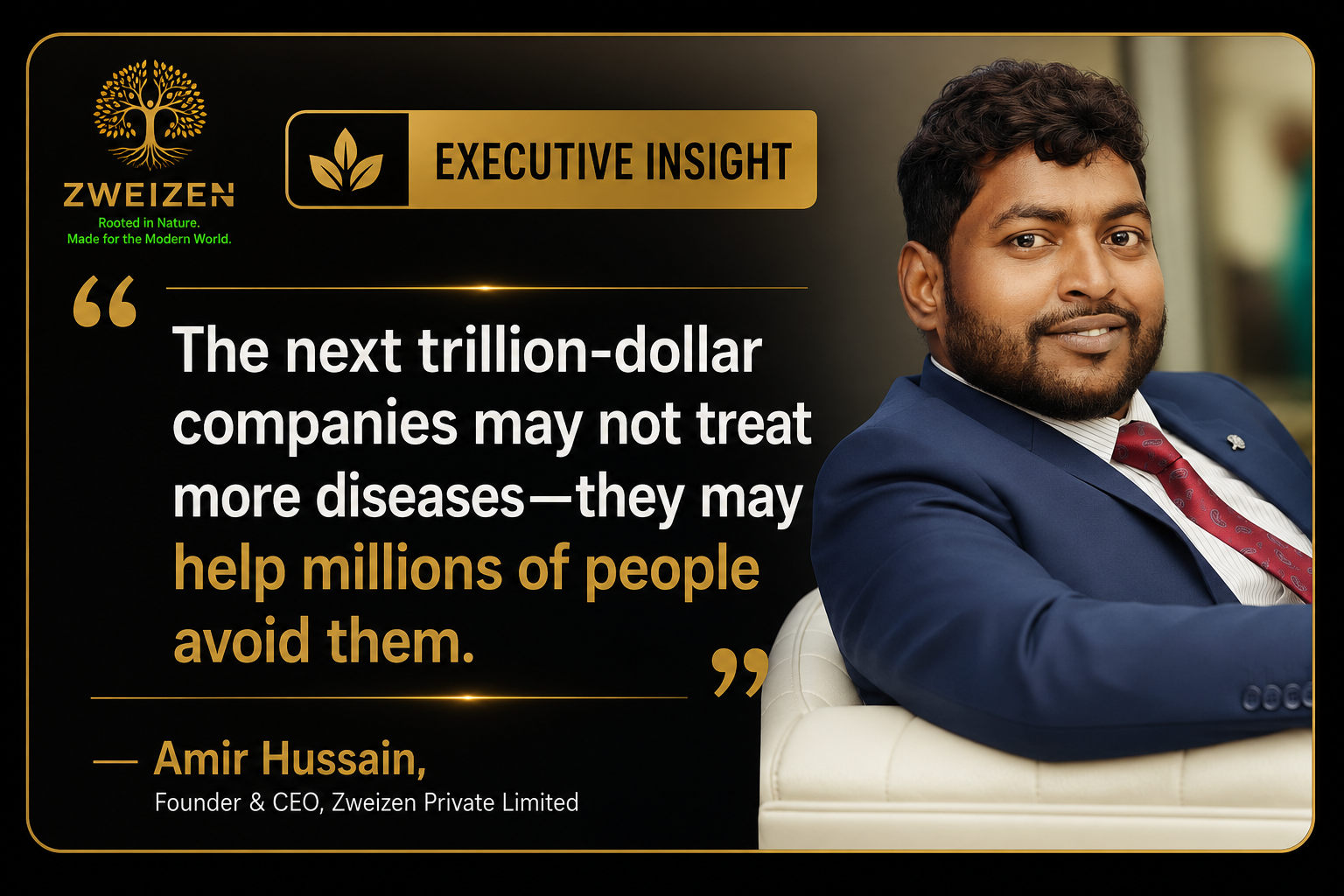
About the Author
Amir Hussain is the Founder & CEO of Zweizen Private Limited, an Indian wellness company focused on preventive health, Ayurvedic wellness, and evidence-informed consumer wellness solutions. His interests include corporate governance, business strategy, digital transformation, entrepreneurship, and the future of the global wellness economy.
Recent Posts
The Wellness Industry Doesn’t Have a Product Problem. It Has a Trust Problem. | Zweizen
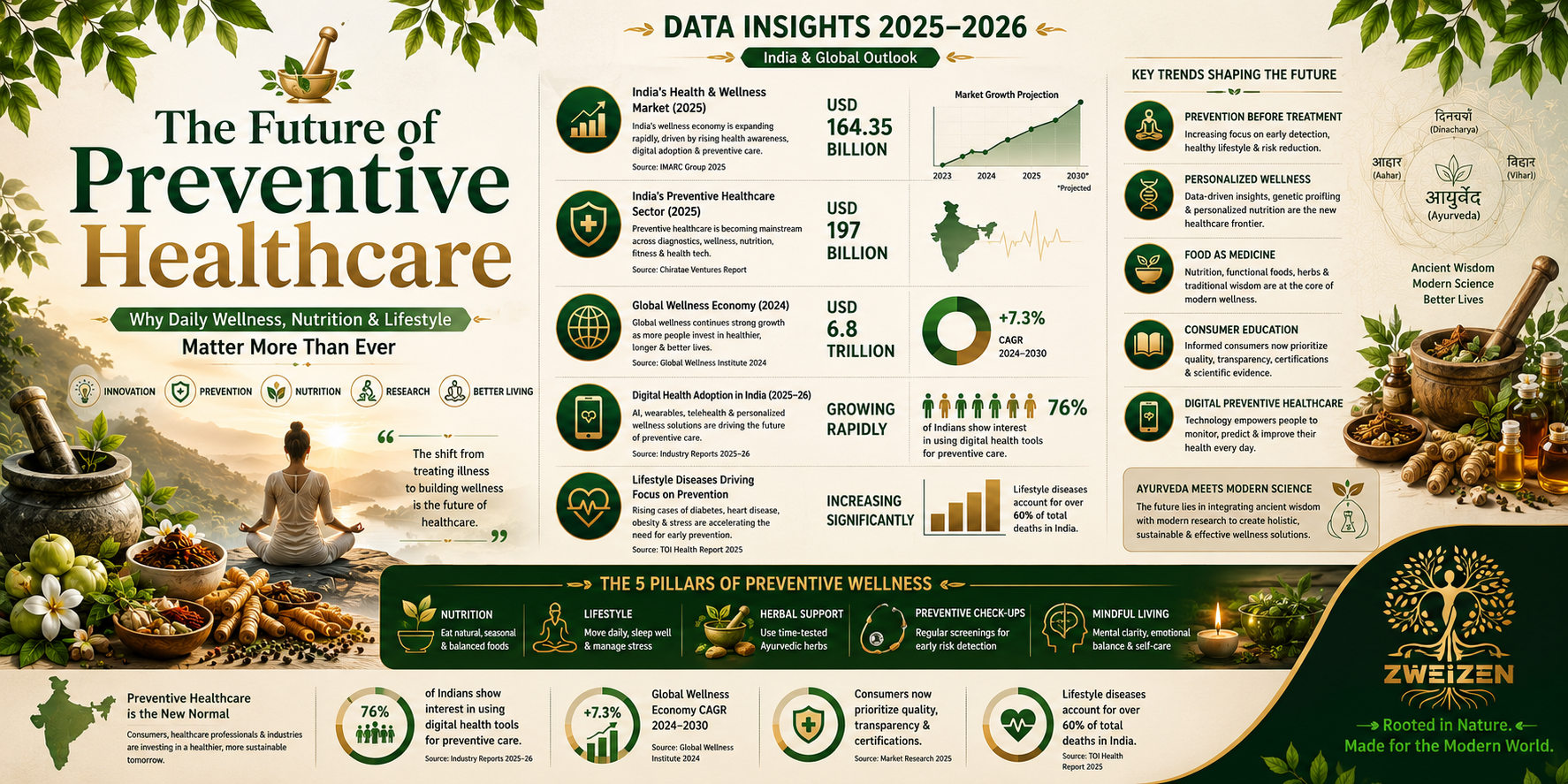
The Future of Preventive Healthcare: Why Daily Wellness, Nutrition & Lifestyle Matter More Than Ever
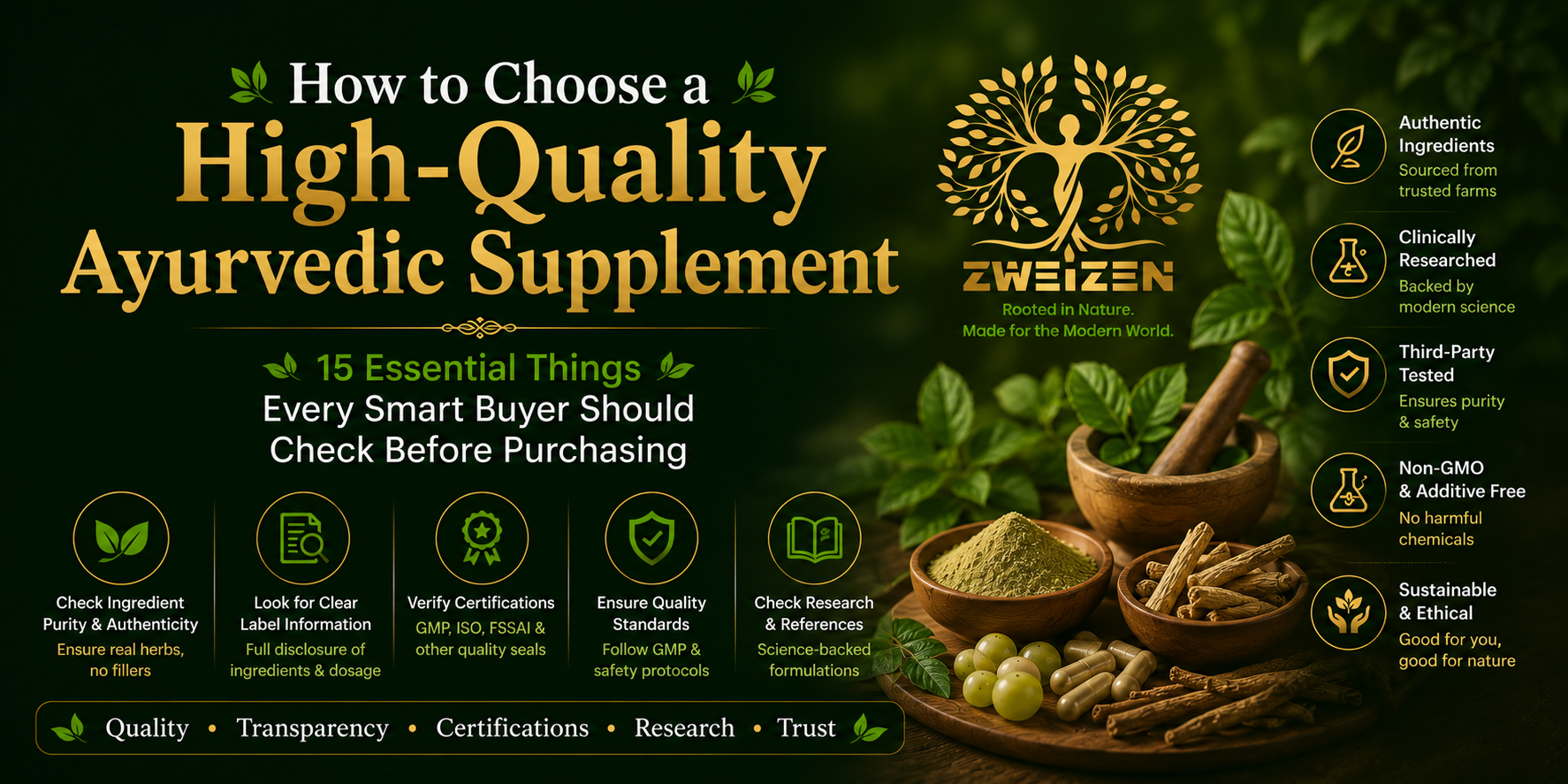
How to Choose a High-Quality Ayurvedic Supplement: 15 Things Every Buyer Should Check
Daily Ayurvedic Routine (Dinacharya): 12 Morning Habits for Better Energy, Digestion & Overall Wellness
How Mindfulness Supports Physical Health: The Mind-Body Connection Explained
Natural Detox Myths vs Facts: What Your Body Really Needs for Effective Cleansing
Ayurvedic Detox Explained: 10 Powerful Botanicals for Gut Health, Daily Cleansing & Wellness Support
Top 15 Ayurvedic Superfoods for Daily Energy, Immunity & Overall Wellness
About Zweizen Private Limited